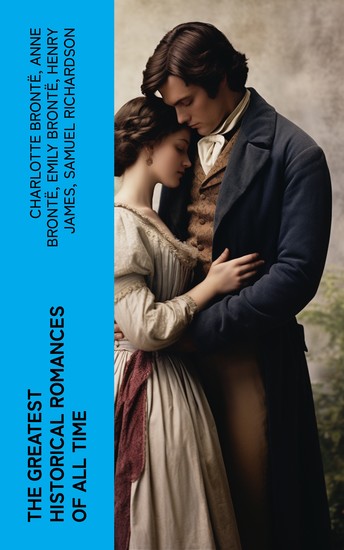
The Greatest Historical Romances of All Time - Classic Tales of Love Intrigue Scandal and Social Change Across the Ages
Jane Austen, Alexandre Dumas, Charlotte Brontë, Emily Brontë, Henry James, Anthony Trollope, Guy De Maupassant, William Makepeace Thackeray, Anne Brontë, Madame de La Fayette, Maria Edgeworth, Louis Hémon, Fanny Burney, Georg Ebers, Henry Fielding, Samuel Richardson, Edith Wharton, F. Scott Fitzgerald, Mary Wollstonecraft, Georgette Heyer, Nathaniel Hawthorne, Sabine Baring-Gould, Grace Livingston Hill, Gilbert Parker, Fanny Fern, Mary Hays, A. E. W. Mason, Thomas Hardy, Eliza Haywood, Bernardin de Saint-Pierre, Philip Meadows Taylor, Lady Sydney Morgan, Robert Williams Buchanan, Leo Tolstoy, Pierre Choderlos de Laclos, D. K. Broster, María Ruiz de Burton, Mrs. Olifant, Catharine Trotter Cockburn, Lady Charlotte Bury, Mary Angela Dickens, W. Somerset Maugham
Publisher: e-artnow
Summary
The Greatest Historical Romances of All Time surveys the historical romance as a capacious form, where private desire meets public crisis, inherited custom, and the imaginative reconstruction of earlier worlds. Spanning epistolary intrigue, Gothic intensity, comedy of manners, realist social panorama, adventure narrative, and psychologically nuanced short fiction, the volume moves from courtly and revolutionary Europe to imperial frontiers and the American past. Its selections illuminate the genre's recurring concerns—class, gender, nation, secrecy, marriage, exile, and memory—while preserving its remarkable tonal range, from restrained irony to melodrama and tragic passion. The collection gathers writers associated with the rise of the novel, Romantic and Victorian historical fiction, realism, sensation writing, and transatlantic modernity. British, French, American, Russian, and Canadian perspectives converge alongside voices that challenge conventional literary canons through attention to colonial encounter, women's agency, and social exclusion. Collectively, these authors demonstrate how romance has served not as an escape from history but as a means of testing how historical forces shape intimate life. This volume is recommended to readers and students seeking a broad, comparative introduction to historical romance. It offers an unusually rich opportunity to trace formal change across centuries and national traditions, while discovering how varied styles produce an ongoing dialogue between love stories and the worlds that constrain, transform, or make them possible.
Available since: 12/11/2023.
Print length: 22909 pages.