¡Acompáñanos a viajar por el mundo de los libros!
Añadir este libro a la estantería
Grey
Escribe un nuevo comentario Default profile 50px
Grey
Suscríbete para leer el libro completo o lee las primeras páginas gratis.
All characters reduced
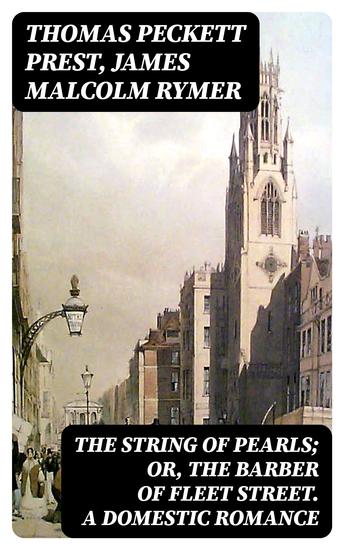
The String of Pearls; Or The Barber of Fleet Street A Domestic Romance - cover

The String of Pearls; Or The Barber of Fleet Street A Domestic Romance

James Malcolm Rymer, Thomas Peckett Prest

Editorial: DigiCat

  • 0
  • 0
  • 0

Sinopsis

The anthology 'The String of Pearls; Or, The Barber of Fleet Street. A Domestic Romance' offers readers a complex exploration of suspenseful narratives woven through themes of intrigue and societal mores. Encompassing a rich variety of literary styles, this collection captures the essence of Victorian-era storytelling—a period marked by its fascination with the macabre and the mysterious. The anthology stands out for its innovative plot elements and the atmospheric tension that reflects the societal anxieties of its time. Among the standout pieces, readers will find tales that unsettle and provoke thought, brilliantly capturing the reader's imagination without the need for singular attribution. Contributing authors Thomas Peckett Prest and James Malcolm Rymer collectively showcase their prowess in gothic and sensation fiction, aligning with the evolving literary movement that underscored narratives with elements of intrigue and domestic tension. Their contributions, reflecting both popular and serialized literature of the 19th century, demonstrate a mastery of creating suspenseful and engaging stories. These voices come together to form a cohesive exploration of cultural and historic shifts, enriching the broader discourse of literary traditions through this period. This collection serves as an indispensable resource for those interested in the interplay between social changes and literary response, providing a unique opportunity to engage with compelling narratives from different perspectives. Academic readers and enthusiasts alike will find 'The String of Pearls' a valuable addition to their collections, offering a breadth of insights and fostering a dialogue that transcends time through its vivid storytelling and thematic depth.
Disponible desde: 28/05/2022.
Longitud de impresión: 1041 páginas.

Otros libros que te pueden interesar

  • The Stalled Ox - cover

    The Stalled Ox

    Hector Hugh Munro

    • 0
    • 1
    • 0
    When Theophil Eshley, the bovine painter, is called upon by his neighbour Adela Pingsford to remove a stray ox from her garden things go inevitably and comically wrong. No oxen are harmed in the course of this story, but sadly the same cannot be said of assorted chrysanthemums, drawing rooms and egos.
    Ver libro
  • A Nocturne - From their pens to your ears genius in every story - cover

    A Nocturne - From their pens to...

    Clothilde Graves

    • 0
    • 0
    • 0
    Clotilde Augusta Inez Mary Graves was born on the 3rd June 1863 at Buttevant Castle, Co. Cork, to parents with military backgrounds. 
    At age nine, the family moved to Southsea in England for yet another military posting.  Her father’s postings gave her valuable experiences that would be put to good use in later years in some of her literary works. 
    She was educated at a Catholic convent in Lourdes before returning to London in 1884 to study art in Bloomsbury.  She worked part-time at the British Museum and the Royal Female School of Art and generated further income by drawing little pen-and-ink grotesques for the comic papers.  
    A few years later a chance meeting found her writing extra lyrics for a pantomime version of Puss in Boots.  She followed up with several financially successful plays, both in London and New York, and gained a measure of notoriety in one with the comparison of marriage and prostitution.   
    Despite her dramatic success she published her first novel in 1911 under the pseudonym of Richard Dehan which she continued to use for later works.  As well as novels and plays she published collections of short stories which glow with talent and invention. 
    She was an unusual figure in London society, wearing her hair short, taking on a masculine manner and cut of clothing, and smoking cigarettes in public when such traits were considered eccentric at best.  Add to this her admired collection of Chinese and Japanese trophies, her enthusiasm for fly-fishing and her riding of a tricycle and you have a perfect image of this fascinating writer. 
    Clotilde Graves died at the convent of Our Lady of Lourdes at Hatch End in Middlesex, on the 3rd December 1932.  She was 69.
    Ver libro
  • The Sea-Wolf - cover

    The Sea-Wolf

    Jack London

    • 0
    • 0
    • 0
    When literary critic Humphrey Van Weyden is rescued from a shipwreck by the seal-hunting schooner Ghost, he enters a world far removed from his sheltered existence. At the helm of the ship is Wolf Larsen—a brutal, brilliant, and enigmatic captain whose philosophy of survival and dominance challenges everything Van Weyden believes. Trapped aboard with a crew ruled by fear and violence, Van Weyden is forced to confront both the physical hardships of life at sea and the psychological warfare of Larsen’s ruthless worldview. 
    A gripping tale of man versus nature, intellect versus instinct, and morality versus might, The Sea-Wolf is one of Jack London’s most powerful and enduring novels. This audiobook brings the storm-lashed Pacific and its unforgettable characters vividly to life in a classic high-seas adventure that is as thought-provoking as it is thrilling. 
    Cover Photo by Nayla Charo: https://www.pexels.com/photo/bird-flying-over-the-sea-wave-4799392/
    Ver libro
  • The Diary of a God - cover

    The Diary of a God

    Barry Pain

    • 0
    • 0
    • 0
    The Diary of a God by Barry Pain is a satirical short story that presents the fictional diary of a deity who observes and reflects upon human behavior and the absurdities of life on Earth. The god, who remains unnamed, details his interactions with humanity, expressing both amusement and frustration at their follies. 
    Ver libro
  • Stories Involving Animal Cruelty - Some humans can be cruel maybe they'll get what's coming to them… - cover

    Stories Involving Animal Cruelty...

    Edgar Allan Poe, Bram Stoker, HP...

    • 0
    • 0
    • 0
    Our best loved friends may not even be human but animals of the moggy and mutt variety.  Many of us wax lyrical about our friends in the animal world no matter the distractions available in the real and rather more demanding world of partners, children, parents and friends.   
     
    So often then that when the media brings news of appalling tragedies across the globe the distress of cruelty to animals seems to gather more immediate attention.   
     
    In this volume our literary wordsmiths turn their attention to tales that make our hearts wince and our emotions bleed.   
     
    1 - Stories About Cruelty to Animals - An Introduction 
    2 - The Black Cat by Edgar Allan Poe 
    3 - The Squaw by Bram Stoker 
    4 - The Cats of Ulthar by H P Lovecraft 
    5 - The Ankardyne Pew by W F Harvey 
    6 - A Dark Brown Dog by Stephen Crane 
    7 - Strychnine for Village Dogs by Arthur Gask
    Ver libro
  • A Journey of Little Profit - From their pens to your ears genius in every story - cover

    A Journey of Little Profit -...

    John Buchan

    • 0
    • 0
    • 0
    The Scottish novelist John Buchan enjoyed a remarkable career as politician, historian and Governor General. He was born John Buchan on 26th August 1875 and later added 1st Baron Tweedsmuir PC GCMG GCVO CH to his name.  
    Buchan studied at Hutchesons’ Grammar School, Glasgow and at seventeen won a scholarship to the University of Glasgow to study classics. There he began to write poetry. In 1895 he transferred to Oxford to continue his study of Classics and in 1896 ‘Sir Quixote of the Moors’ was published followed by the non-fiction ‘Scholar-Gipsies’. His prolific literary output now hardly faltered. 
    He graduated in 1900 and became the private secretary to Alfred Milner, the High Commissioner for Southern Africa and other colonies. Buchan found the same inspiration in the African landscape as he had in the Scottish Borders, and would later set many works here. Returning to London he became a partner in a publishing house, and garnered an editorial role at The Spectator. He also completed his law studies. He was called to the bar in 1901 but never practiced.  
    On 15th July 1907 Buchan married Susan Charlotte Grosvenor, the cousin of the Duke of Westminster. In 1910 he wrote ‘Prester John’, the first of a series set in South Africa.  
    In 1911 Buchan entered politics as a Unionist candidate in the Scottish Borders advocating the support of free trade, women’s suffrage, national insurance, and reducing the power of the House of Lords.  
    The Great War saw Buchan writing for the War Propaganda Bureau and as Times correspondent in France. In 1915, he published ‘The Thirty-Nine Steps’, his most famous book and a follow-up Richard Hannay novel, ‘Greenmantle’, in 1916.  
    In 1916 Buchan enlisted in the Intelligence Corps which included writing speeches for Sir Douglas Haig. By 1917 he was Director of Information under Lord Beaverbrook. Buchan called it “the toughest job he ever took on”. He somehow found time to assist in a history of the war magazine. This was later published in 24 volumes: Nelson’s History of the War. 
    After the war his writing focused on historical studies. In 1927 Buchan became the Unionist Party Member of Parliament for the Combined Scottish Universities. In a speech to Parliament he said “I believe every Scotsman should be a Scottish nationalist. If it could be proved that a Scottish parliament were desirable… Scotsmen should support it.”  
    Over the next decade he continued to distinguish himself politically and in literature.  On the 1st June 1935 he became 1st Baron Tweedsmuir of Elsfield in the County of Oxford.  
    He was now also given the position of Governor General in Canada and resolved to travel all over Canada to gain a better insight of the country. Having crossed both length and breadth he saw the cultural shift between areas and their common ground and helped bring about a clear national Canadian identity. 
    On the 6th February 1940 he collapsed from a stroke and sustained a very serious head injury in falling. Two rounds of surgery to stabilise his condition were unsuccessful and Buchan died on the 11th February. After a state funeral in Ottawa his ashes were returned to his estate in Oxfordshire.
    Ver libro