Join us on a literary world trip!
Add this book to bookshelf
Grey
Write a new comment Default profile 50px
Grey
Subscribe to read the full book or read the first pages for free!
All characters reduced
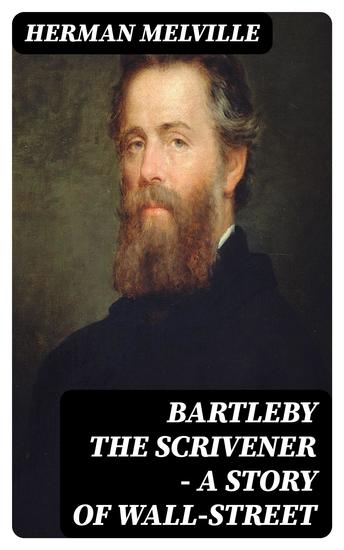
Bartleby the Scrivener — A Story of Wall-Street - cover

Bartleby the Scrivener — A Story of Wall-Street

Herman Melville

Publisher: DigiCat

  • 0
  • 0
  • 0

Summary

In "Bartleby the Scrivener: A Story of Wall-Street," Herman Melville crafts a profound narrative that explores themes of isolation, passive resistance, and the dehumanizing effects of modern capitalism. Through the character of Bartleby, a scrivener whose refrain of "I would prefer not to" encapsulates his profound disengagement from societal expectations, Melville employs a minimalist yet poignant style that reflects both the starkness of Wall Street and the complexity of human nature. The story's setting against the backdrop of 19th-century New York serves as a critical commentary on the economic ambitions and moral dissonance of the time, echoing the existential concerns that arise in a rapidly industrializing world. Herman Melville, an author underscored by the struggles with his own identity and societal roles, draws from his experiences and observations in an era marked by economic upheaval. Despite initial obscurity, Melville's later recognition as a key figure in American literature was bolstered by his exploration of complex themes in works like "Moby-Dick" and "Billy Budd." His engagement with the contradictions of human ambition and individualism is evident in Bartleby's enigmatic presence, reflecting Melville's own ambivalence toward capitalism and modernity. "Bartleby the Scrivener" is highly recommended for readers interested in existential literature, economic critique, and the profound implications of passive resistance. This text remains a seminal work in understanding the human condition, raising questions about free will, societal expectations, and the individual's struggle within the mechanisms of commerce. Melville's rich prose and intricate character exploration invite readers to reflect deeply on their own existence and the nature of work in a modern society.
Available since: 05/29/2022.
Print length: 36 pages.

Other books that might interest you

  • Keeping Your Word (Unabridged) - cover

    Keeping Your Word (Unabridged)

    Booker T. Washington

    • 0
    • 0
    • 0
    Booker Taliaferro Washington (April 5, 1856 - November 14, 1915) was an American educator, author, orator, and adviser to several presidents of the United States. Between 1890 and 1915, Washington was the dominant leader in the African American community and of the contemporary black elite. Washington was from the last generation of black American leaders born into slavery and became the leading voice of the former slaves and their descendants. They were newly oppressed in the South by disenfranchisement and the Jim Crow discriminatory laws enacted in the post-Reconstruction Southern states in the late 19th and early 20th centuries.
    KEEPING YOUR WORD: I do not want to speak to you continually upon subjects that tend to show up the weaker traits of character which our race has, but there are some characteristic points in our life so important that it seems to me well that we emphasize those which are specially weak just now.
    Show book
  • First and Last Things (Unabridged) - cover

    First and Last Things (Unabridged)

    H. G. Wells

    • 0
    • 0
    • 0
    First and Last Things is a 1908 work of philosophy by H. G. Wells setting forth his beliefs in four "books" entitled "Metaphysics," "Of Belief," "Of General Conduct," and "Some Personal Things." Parts of the book were published in the Independent Magazine in July and August 1908. Wells revised the book extensively in 1917, in response to his religious conversion, but later published a further revision in 1929 that restored much of the book to its earlier form. Its main intellectual influences are Darwinism and certain German thinkers Wells had read, such as August Weismann. The pragmatism of William James, who had become a friend of Wells, was also an influence.
    Show book
  • Return of the Soldier - cover

    Return of the Soldier

    Rebecca West

    • 0
    • 0
    • 0
    Set during World War I, The Return of the Soldier tells the story of Chris Baldry, a British soldier who returns home after being wounded in battle. However, his injury is not physical—instead, it causes him to suffer from amnesia, erasing the past fifteen years of his life. As a result, Chris believes that he is still living in the year 1916, before the war began, and has forgotten all the events of his adult life, including his marriage to his wife, Kitty.
    
    Chris's return brings together several key women in his life: Kitty, his wife; Jenny, his cousin and confidante; and Margaret, the woman Chris had loved before his marriage. Each of these women reacts to Chris's return in different ways, and their relationships with him are complicated by his amnesia.
    The Return of the Soldier is a poignant exploration of how war disrupts not just the lives of soldiers, but also the emotional and psychological lives of those around them.
    Show book
  • The Trial For Murder - cover

    The Trial For Murder

    Charles Dickens

    • 0
    • 0
    • 0
    In The Trial for Murder, Charles Dickens delivers a chilling and suspenseful ghost story set in the tension-filled backdrop of a courtroom. When an ordinary man is selected to serve on a jury, he finds himself haunted by the ghost of the murder victim, who seems determined to influence the outcome of the trial. As the eerie presence grows stronger, the line between the natural and the supernatural blurs, leading to a suspenseful and eerie conclusion. 
    Narrated by N. W. Edwards, this audiobook brings the eerie atmosphere of the story to life, with rich and evocative tones that capture the suspense and unease of Dickens’ supernatural courtroom drama. Perfect for fans of classic horror and ghost stories, The Trial for Murder will leave listeners with a lingering sense of mystery and dread.
    Show book
  • Tono-Bungay - Book the Fourth: The Aftermath of Tono-Bungay (Unabridged) - cover

    Tono-Bungay - Book the Fourth:...

    H. G. Wells

    • 0
    • 0
    • 0
    Herbert George "H. G." Wells (1866 - 1946) was an English writer.
    He was prolific in many genres, including the novel, history, politics, social commentary, and textbooks and rules for war games. Wells is now best remembered for his science fiction novels and is called a "father of science fiction"
    BOOK THE FOURTH: THE AFTERMATH OF TONO-BUNGAY: That evening I talked with my uncle in the Hardingham for the last time. The atmosphere of the place had altered quite shockingly. Instead of the crowd of importunate courtiers there were just half a dozen uninviting men, journalists waiting for an interview. Ropper the big commissionaire was still there, but now indeed he was defending my uncle from something more than time-wasting intrusions. I found the little man alone in the inner office pretending to work, but really brooding. He was looking yellow and deflated.
    Show book
  • Rudyard Kipling - Six of the Best - Their legacy in 6 classic stories - cover

    Rudyard Kipling - Six of the...

    Rudyard Kipling

    • 0
    • 0
    • 0
    Six has always been a number we group things around – Six of the best, six of one half a dozen of another, six feet under, six pack, six degrees of separation and a sixth sense are but a few of the ways we use this number. 
     
    Such is its popularity that we thought it is also a very good way of challenging and investigating an author’s work to give width, brevity, humour and depth across six of their very best. 
     
    In this series we gather together authors whose short stories both rivet the attention and inspire the imagination to visit their gems in a series of six, to roam across an author’s legacy in a few short hours and gain a greater understanding of their writing and, of course, to be lavishly entertained by their ideas, their narrative and their way with words. 
     
    These stories can be surprising and sometimes at a tangent to what we expected, but each is fully formed and a marvellous adventure into the world and words of a literary master. 
     
    1 - Six of the Best - Rudyard Kipling - An Introduction 
    2 - Rudyard Kipling - An Introduction 
    3 - The Phantom Rickshaw By Rudyard Kipling 
    4 - They by Rudyard Kipling 
    5 - Mary Postgate by Rudyard Kipling 
    6 - Mark Of The Beast By Rudyard Kipling 
    7 - The Maltese Cat by Rudyard Kipling 
    8 - The Man Who Would Be King - Part 1 by Rudyard Kipling 
    9 - The Man Who Would Be King - Part 2 by Rudyard Kipling
    Show book