Rejoignez-nous pour un voyage dans le monde des livres!
Ajouter ce livre à l'électronique
Grey
Ecrivez un nouveau commentaire Default profile 50px
Grey
Abonnez-vous pour lire le livre complet ou lisez les premières pages gratuitement!
All characters reduced
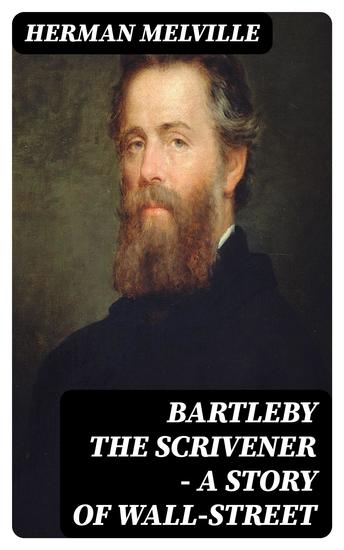
Bartleby the Scrivener — A Story of Wall-Street - cover

Bartleby the Scrivener — A Story of Wall-Street

Herman Melville

Maison d'édition: DigiCat

  • 0
  • 0
  • 0

Synopsis

In "Bartleby the Scrivener: A Story of Wall-Street," Herman Melville crafts a profound narrative that explores themes of isolation, passive resistance, and the dehumanizing effects of modern capitalism. Through the character of Bartleby, a scrivener whose refrain of "I would prefer not to" encapsulates his profound disengagement from societal expectations, Melville employs a minimalist yet poignant style that reflects both the starkness of Wall Street and the complexity of human nature. The story's setting against the backdrop of 19th-century New York serves as a critical commentary on the economic ambitions and moral dissonance of the time, echoing the existential concerns that arise in a rapidly industrializing world. Herman Melville, an author underscored by the struggles with his own identity and societal roles, draws from his experiences and observations in an era marked by economic upheaval. Despite initial obscurity, Melville's later recognition as a key figure in American literature was bolstered by his exploration of complex themes in works like "Moby-Dick" and "Billy Budd." His engagement with the contradictions of human ambition and individualism is evident in Bartleby's enigmatic presence, reflecting Melville's own ambivalence toward capitalism and modernity. "Bartleby the Scrivener" is highly recommended for readers interested in existential literature, economic critique, and the profound implications of passive resistance. This text remains a seminal work in understanding the human condition, raising questions about free will, societal expectations, and the individual's struggle within the mechanisms of commerce. Melville's rich prose and intricate character exploration invite readers to reflect deeply on their own existence and the nature of work in a modern society.
Disponible depuis: 29/05/2022.
Longueur d'impression: 36 pages.

D'autres livres qui pourraient vous intéresser

  • Ulysses - cover

    Ulysses

    James Joyce

    • 0
    • 5
    • 2
    This iconic work of experimental modernism “comes nearer to being the perfect revelation of a personality than any book in existence” (The New York Times).   Taking place on June 16, 1904, Ulysses follows the itinerant journeys of Leopold Bloom and Stephen Dedalus as they make their way through an ordinary day in Dublin. With stream-of-conscious narration, Joyce weaves a sprawling yet incisive portrait of his characters, the nature of desire, and Dublin itself.   First published in Paris in 1922, Joyce’s masterwork was once banned for obscenity in the United States and Britain. Hailed as a work of genius by Ezra Pound, Ernest Hemingway, and many others, Ulysses remains one of the most significant works in English literature.
    Voir livre
  • Tarzan of the Apes - cover

    Tarzan of the Apes

    edgar rice burroughs

    • 0
    • 0
    • 0
    An adventure tale that has capture the ages! The first book in the legendary Tarzan series tells the story of John Clayton, born in the coastal jungles of Africa to a marooned couple from England, adopted as an infant by apes after they die, then raised in ignorance of his human heritage. Through sheer force of will Tarzan becomes king of the jungle and slowly learns of his origin.This is the exciting novel that began it all.
    Voir livre
  • Hard Times - Stories For Everyone - cover

    Hard Times - Stories For Everyone

    Charles Dickens

    • 0
    • 0
    • 0
    “Now, what I want is Facts. Teach these boys and girls nothing but Facts. Facts alone are wanted in life. Plant nothing else, and root out everything else. You can only form the minds of reasoning animals upon Facts; nothing else will ever be of any service to them.” 
     
    ― Charles Dickens, Hard Times 
     
    Hard Times is the tenth novel by Charles Dickens, first published in 1854. The book surveys English society and satirizes the social and economic conditions of the era. 
     
    Hard Times is unusual in several ways. It is by far the shortest of Dickens's novels, barely a quarter of the length of those written immediately before and after it. Moreover, it is his only novel not to have scenes set in London. Instead, the story is set in the fictitious Victorian industrial Coketown, a generic Northern English mill-town. 
     
    The story concerns one Thomas Gradgrind, a "fanatic of the demonstrable fact," who raises his children, Tom and Louisa, in a stifling and arid atmosphere of grim practicality. A classic audiobook publishing event. Charles John Huffam Dickens FRSA was an English writer and social critic. He created some of the world's best-known fictional characters and is regarded by many as the greatest novelist of the Victorian era.
    Voir livre
  • The Trumpet Major - cover

    The Trumpet Major

    Thomas Hardy

    • 0
    • 0
    • 0
    The Trumpet-Major is the seventh published novel by English author Thomas Hardy published in 1880, and his only historical novel. 
    When Anne Garland wakes up one morning, she little realises the significance of the sight from her window; of soldiers setting up camp for the summer on the hills overlooking her quiet village of Overcombe.  
    But she soon finds herself pursued romantically by three men: Trumpet Major John Loveday, his brother Bob and the boorish Squire's nephew and yeoman; Festus Derrimen, as the Napoleonic war roils over the continent. All three compete off and on for her affections, but who will finally win her hand?  
    Narrated by Michael Ward.
    Voir livre
  • A Hunger Artist - cover

    A Hunger Artist

    Franz Kafka

    • 0
    • 0
    • 0
    A Hunger Artist is a short story by Franz Kafka.     The protagonist, a hunger artist who experiences the decline in appreciation of his craft, is an archetypical creation of Kafka: an individual marginalized and victimized by society at large. The title of the story has been translated also to "A Fasting Artist" and "A Starvation Artist".    A Hunger Artist explores the familiar Kafka themes of death, art, isolation, asceticism, spiritual poverty, futility, personal failure and the corruption of human relationships.    There is a sharp division among critical interpretations of "A Hunger Artist". Most commentators concur that the story is an allegory, but they disagree as to what is represented. Some critics, pointing to the hunger artist's asceticism, regard him as a saintly or even Christ-like figure. In support of this view they emphasize the unworldliness of the protagonist, the priest-like quality of the watchers, and the traditional religious significance of the forty-day period. Other critics insist that A Hunger Artist is an allegory of the misunderstood artist, whose vision of transcendence and artistic excellence is rejected or ignored by the public. This interpretation is sometimes joined with a reading of the story as autobiographical. According to this view, this story, written near the end of Kafka's life, links the hunger artist with the author as an alienated artist who is dying.    The moral of the story, says literature critic Maud Ellmann, is that it is not by food that we survive but by the gaze of others and "it is impossible to live by hunger unless we can be seen or represent doing so".
    Voir livre
  • Holding a Mirror Up to Nature - cover

    Holding a Mirror Up to Nature

    James Gilligan, David A.J. Richards

    • 0
    • 0
    • 0
    At a time when violence in America and Europe dominates the daily news, a groundbreaking new book co-authored by James Gilligan, an eminent psychiatrist who has worked with criminals, and David A.J. Richards, a legal scholar of toxic patriarchy, illuminates the ways in which Shakespeare offers unique insights into the causes of violence as well as its prevention.Now a riveting new audio production, Holding a Mirror Up to Nature: Shame, Guilt, and Violence in Shakespeare takes advantage of scenes performed by acclaimed actors to dramatize how much Shakespeare’s tragic heroes exhibit the psychology of those who commit violence in the contemporary world.The voice of British-American actor John Douglas Thompson called “perhaps the greatest Shakespeare interpreter in contemporary theater,” together with women’s parts spoken by Shakespeare & Company’s distinguished Tod Randolph, and narration by award-winning theater star Nigel Gore, orchestrate this tour de force audiobook that belongs in the listening library of everyone who loves Shakespeare and is curious about what causes and what prevents violence.
    Voir livre