Join us on a literary world trip!
Add this book to bookshelf
Grey
Write a new comment Default profile 50px
Grey
Subscribe to read the full book or read the first pages for free!
All characters reduced
Ghosts - cover

Ghosts

Henrik Ibsen

Publisher: CLXBX

  • 0
  • 0
  • 0

Summary

Henrik Ibsen's Ghosts is a powerful and provocative drama that dares to confront the hidden truths lurking beneath respectable society. First published in 1881, this groundbreaking play shocked audiences of its time with its fearless exploration of morality, duty, hypocrisy, and the haunting consequences of past actions. Today, it remains one of Ibsen's most compelling and widely studied works.

Set in a remote Norwegian town, Ghosts centers on Mrs. Helene Alving, a widow preparing to open an orphanage in memory of her late husband, Captain Alving. To the outside world, the Captain was a pillar of the community—honorable, charitable, and morally upright. But beneath this carefully maintained façade lies a far darker truth. As the story unfolds over the course of a single day, long-buried secrets begin to surface, threatening to shatter the lives of everyone involved.

Mrs. Alving has spent years protecting her son, Oswald, from the corruption and moral decay she associates with his father. Having sent him away to Paris to shield him from his father's influence, she hopes he will live a life free from the "ghosts" of the past. However, Oswald returns home carrying burdens of his own—both emotional and physical. His struggles reveal the devastating consequences of inherited guilt and societal repression.

The play also features Pastor Manders, a well-meaning but rigid clergyman who represents the moral authority of society. Through his interactions with Mrs. Alving, Ibsen exposes the suffocating power of social expectations and the destructive force of blind adherence to tradition. Manders' concern for appearances over truth becomes a sharp critique of institutions that prioritize reputation above genuine compassion.

Another key figure, Engstrand, a cunning and opportunistic carpenter, and his daughter Regina, who works in Mrs. Alving's household, further complicate the web of secrets. As relationships unravel and hidden connections are revealed, Ibsen masterfully builds tension toward a tragic and unforgettable conclusion.

The title Ghosts operates on multiple levels. The "ghosts" are not literal spirits, but rather the lingering presence of past sins, outdated beliefs, and inherited ideologies that continue to shape the present. Ibsen suggests that individuals are haunted not only by personal mistakes but also by societal conventions that persist unquestioned across generations. These invisible forces exert a powerful influence, trapping characters in cycles of suffering and denial.

At its core, Ghosts is a searing examination of truth versus illusion. Ibsen challenges the notion that maintaining appearances is more important than confronting reality. The play boldly addresses controversial themes such as venereal disease, illegitimacy, euthanasia, and the oppression of women—topics considered scandalous at the time of its release. Yet its enduring relevance lies in its exploration of universal human struggles: the tension between duty and freedom, love and responsibility, truth and comfort.

Written in Ibsen's signature realist style, Ghosts strips away romanticism to reveal the stark complexities of human relationships. Its tightly constructed dialogue and psychological depth create a gripping drama that forces readers and audiences alike to question their own beliefs about morality, family, and societal norms.

More than a century after its debut, Ghosts remains a timeless masterpiece—an unflinching portrayal of how the past shapes the present, and a profound reminder that the truths we avoid often return to confront us in the most devastating ways.
Available since: 03/03/2026.
Print length: 85 pages.

Other books that might interest you

  • Matters Of Urgency (Biz) - cover

    Matters Of Urgency (Biz)

    Mike Blake

    • 0
    • 0
    • 0
    Matters Of Urgency (Biz)  
    A poem about the cut and thrust of the Business world.  
    How businesses in the boardroom deal with the aspects of promotion, and denigrate those who fail to  
    meet the grade. It mentions some of the tools used to sift out the doers from the  
    non-doers. The movers and shakers from the chaffs and fakers. 
    The boardroom is a tense place to be, when your egging for your promotion. 
    On the edge of your dreams in your business schemes. 
    *NO A.I. has been used in the creation of this Poem. Purely 100% inspirational from the Author. 
    * As for all my poems.* 
    To see more other Poems by the same Author please click the Link HERE: 
    https://www.amazon.com/-/e/B00SG40RM8 
    Instagram: wild_poetrys     //    wild.poetry.webs 
    TikTok:   @Wild_Poetrys
    Show book
  • The correct fury of your why is a mountain - cover

    The correct fury of your why is...

    Kevin Andrew Heslop

    • 0
    • 0
    • 0
    Poet-critic Jim Johnstone has described Kevin Heslop's the correct fury of your why is a mountain as among “the most promising poetic projects to come out of Canada in recent years.” This debut collection communicates Heslop’s sense of balance as a visual artist, curator, and poet who weights the page with visual harmony. By turns experiment, lyric, and incantation, the book nods to its author’s training as an actor, combining a command of language, form, character, and polyphony to make something performatively unique.
    Show book
  • To My Most Dearly Beloved Friend - Michael Drayton has often been neglected down the centuries This poem will make you question just why that happened - cover

    To My Most Dearly Beloved Friend...

    Michael Drayton

    • 0
    • 0
    • 0
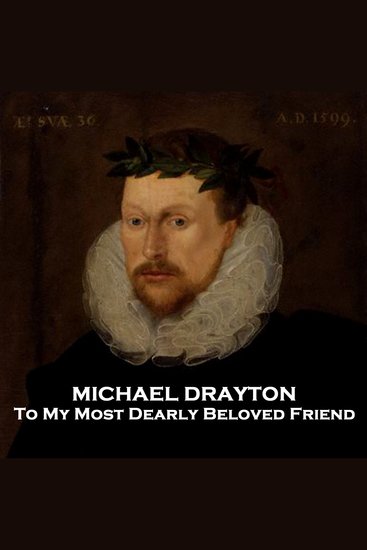
    Michael Drayton was born in 1563 at Hartshill, near Nuneaton, Warwickshire, England. The facts of his early life remain unknown.  Drayton first published, in 1590, a volume of spiritual poems; The Harmony of the Church.  Ironically the Archbishop of Canterbury seized almost the entire edition and had it destroyed.  In 1593 he published Idea: The Shepherd's Garland, 9 pastorals celebrating his own love-sorrows under the poetic name of Rowland. This was later expanded to a 64 sonnet cycle.  With the publication of The Legend of Piers Gaveston, Matilda and Mortimeriados, later enlarged and re-published, in 1603, under the title of The Barons' Wars. His career began to gather interest and attention.  In 1596, The Legend of Robert, Duke of Normandy, another historical poem was published, followed in 1597 by England's Heroical Epistles, a series of historical studies, in imitation of those of Ovid. Written in the heroic couplet, they contain some of his finest writing.  Like other poets of his era, Drayton wrote for the theatre; but unlike Shakespeare, Jonson, or Samuel Daniel, he invested little of his art in the genre. Between 1597 and 1602, Drayton was a member of the stable of playwrights who worked for Philip Henslowe. Henslowe's Diary links Drayton's name with 23 plays from that period, and, for all but one unfinished work, in collaboration with others such as Thomas Dekker, Anthony Munday, and Henry Chettle. Only one play has survived; Part 1 of Sir John Oldcastle, which Drayton wrote with Munday, Robert Wilson, and Richard Hathwaye but little of Drayton can be seen in its pages.  By this time, as a poet, Drayton was well received and admired at the Court of Elizabeth 1st. If he hoped to continue that admiration with the accession of James 1st he thought wrong.  In 1603, he addressed a poem of compliment to James I, but it was ridiculed, and his services rudely rejected.  In 1605 Drayton reprinted his most important works; the historical poems and the Idea. Also published was a fantastic satire called The Man in the Moon and, for the for the first time the famous Ballad of Agincourt.  Since 1598 he had worked on Poly-Olbion, a work to celebrate all the points of topographical or antiquarian interest in Great Britain. Eighteen books in total, the first were published in 1614 and the last in 1622.  In 1627 he published another of his miscellaneous volumes.  In it Drayton printed The Battle of Agincourt (an historical poem but not to be confused with his ballad on the same subject), The Miseries of Queen Margaret, and the acclaimed Nimphidia, the Court of Faery, as well as several other important pieces.  Drayton last published in 1630 with The Muses' Elizium.  Michael Drayton died in London on December 23rd, 1631.  He was buried in Westminster Abbey, in Poets' Corner.  A monument was placed there with memorial lines attributed to Ben Jonson.
    Show book
  • Kaika - cover

    Kaika

    Tara A. Devlin

    • 0
    • 0
    • 0
    There’s something wrong with the house. 
    It was meant to be a fresh new start for the both of them. Instead, it was the beginning of a nightmare. 
    The old but otherwise unassuming house was the only place available on such short notice, and Hideo didn’t think to question it. Perhaps he should have, because it’s not long until he notices changes in his daughter Suzuka, and they’re not changes for the better. 
    Something’s in there with them, and it hungers for blood. Will they make it alive? 
    Click the buy button right now to discover what really lurks in the darkness. 
    The Torihada Files is a series of stand-alone Japanese horror novels set within the same universe. Featuring ghosts, curses, and other supernatural horrors you’ll find only in Japan, each story in The Torihada Files can be read independently of the rest.
    Show book
  • Summer Night in the Beehive - cover

    Summer Night in the Beehive

    Charles Tennyson Turner

    • 0
    • 0
    • 0
    LibriVox volunteers bring you ten recordings of "A Summer Night in the Beehive." The Weekly Poem for August 24, 2014 brings us the night sounds of the meadow in summer.
    Show book
  • A Birthday - cover

    A Birthday

    Christina Rossetti

    • 0
    • 0
    • 0
    LibriVox volunteers bring you 14 recordings of A Birthday by Christina Rossetti. This was the Weekly Poetry project for June 13th, 2010.
    Show book