¡Acompáñanos a viajar por el mundo de los libros!
Añadir este libro a la estantería
Grey
Escribe un nuevo comentario Default profile 50px
Grey
Suscríbete para leer el libro completo o lee las primeras páginas gratis.
All characters reduced
Deerbrook - cover

Deerbrook

Harriet Martineau

Editorial: DigiCat

  • 0
  • 0
  • 0

Sinopsis

In "Deerbrook," Harriet Martineau presents a richly woven narrative that explores the themes of social reform, gender roles, and the moral implications of industrial society. Utilizing a realist literary style, Martineau captures the complexities of human relationships in a rural village setting, which serves as a microcosm of broader societal issues. The novel deftly intersperses dialogue and vivid descriptions, highlighting the lives of its characters against the backdrop of early 19th-century England, a time marked by significant socio-economic changes and emerging debates about women's rights and personal agency. Harriet Martineau was a groundbreaking sociologist, an advocate for women's rights, and one of the first female writers to gain prominence in a male-dominated literary and intellectual landscape. Her personal experiences with social injustice and advocacy for various reform movements energized her writing, which often sought to unveil the realities faced by women in society. "Deerbrook" reflects her keen observational skills and desire to provoke thought and action among her readers, emphasizing the moral responsibilities of individuals in an evolving world. For those interested in Victorian literature and feminist themes, "Deerbrook" is an essential read. Martineau's insightful critique of the societal structures of her time remains relevant today, making this novel a potent exploration of personal and social dilemmas that resonate with contemporary audiences.
Disponible desde: 01/08/2022.
Longitud de impresión: 528 páginas.
Otros libros que te pueden interesar

  • Her Turn - From their pens to your ears genius in every story - cover

    Her Turn - From their pens to...

    D H Lawrence

    • 0
    • 0
    • 0
    David Herbert Lawrence was born on the 11th September 1885 in Eastwood, Nottinghamshire, a coal mining town where the reality of a harsh life was only useful as experiences for future literary works. 
    He was educated at Beauvale Board School and became the first local boy to receive a scholarship to attend Nottingham High School. After 3 years he became a junior clerk in Haywood’s surgical appliances factory. He was also attempting a literary career which, in the short term, led to a teacher training position in Eastwood and later a teaching qualification from University College, Nottingham.  
    Lawrence’s first efforts were poems, short stories and a draft of ‘The White Peacock’. Moving to London and a teaching position in Croydon his writing attracted the attention of Ford Madox Ford, editor of The English Review, and he commissioned him to write ‘Odour of Chrysanthemums’.  
    Wanting to write full-time he now began work on what would become ‘Sons and Lovers.   
    In 1912 he met the older and married mother-of-three Frieda Weekley. They eloped to Germany and here Lawrence could see for himself the growing tensions with France.  So keen was his interest that he was arrested and accused of being a British spy.  
    In early 1914 Frieda obtained her divorce and they returned to Britain to be married just days before the outbreak of war. Owing to her German parentage, and his own public dislike of militarism and violence, the couple were treated with contempt and suspicion throughout the war years.  
    Despite this he continued to write but his reputation in England was so tarnished and, mirrored by his own disdain for the country, he and Frieda left England in November 1919, first for Europe and then America via Ceylon and Australia. 
    They bought a ranch in Taos, New Mexico and visited Mexico several times. The third visit in March 1925 caused a near fatal attack of malaria. To convalesce they moved to Florence. Here he continued work on ‘Lady Chatterley’s Lover’ which for many years would cause controversy. A renewed interest in oil painting resulted in an exhibition in 1929 which was raided by the police and several works were confiscated.  
    D H Lawrence died of complications arising from a bout of tuberculosis on the 2nd of March 1930 in Vence, France.  He was 44.
    Ver libro
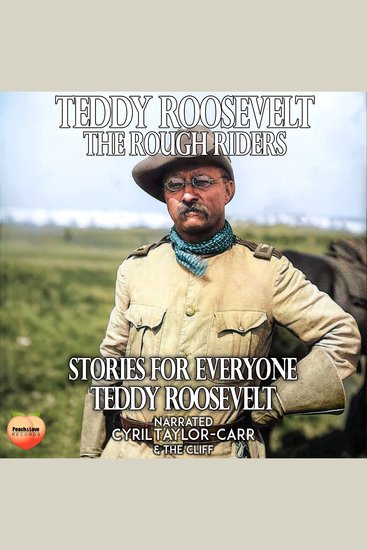
  • Teddy Roosevelt The Rough Riders - Stories For Everyone - cover

    Teddy Roosevelt The Rough Riders...

    Teddy Roosevelt

    • 0
    • 0
    • 0
    The Rough Riders was a nickname given to the 1st United States Volunteer Cavalry, one of three such regiments raised in 1898 for the Spanish–American War and the only one to see combat. The United States Army was small, understaffed, and disorganized in comparison to its status during the American Civil War roughly thirty years prior. Following the sinking of USS Maine, President William McKinley needed to muster a strong ground force swiftly, which he did by calling for 125,000 volunteers to assist in the war. The U.S. had gone to war in opposition to Spanish colonial policies in Cuba, which was then torn by a rebellion.[1] The regiment was also nicknamed "Wood's Weary Walkers" for its first commander, Colonel Leonard Wood. This reflected their dissatisfaction that despite being cavalry, they ended up fighting in Cuba as infantry since their horses were not sent there with them. 
     
    Wood's second in command was former Assistant Secretary of the Navy Theodore Roosevelt, a strong advocate for the Cuban War of Independence. When Wood was promoted to become commander of the 2nd Cavalry Brigade, the regiment became known as "Roosevelt's Rough Riders." That term was borrowed from Buffalo Bill, who called his traveling Western show "Buffalo Bill's Wild West and Congress of Rough Riders of the World." 
     
    The original plan called for the regiment to be composed of frontiersmen from the Indian Territory, the New Mexico Territory, the Arizona Territory, and the Oklahoma Territory. However, after Roosevelt joined the ranks, it attracted an odd mixture of Ivy League athletes, glee club singers, Texas Rangers, and Native Americans. All accepted into the regiment had to be skilled horsemen and eager to see combat. The Rough Riders would receive more publicity than any other Army unit in that war, and they are best remembered for their conduct during the Battle of San Juan Hill.
    Ver libro
  • Diamond Maker The (Unabridged) - cover

    Diamond Maker The (Unabridged)

    H. G. Wells

    • 0
    • 0
    • 0
    Herbert George Wells (21 September 1866 - 13 August 1946) was an English writer. Prolific in many genres, he wrote dozens of novels, short stories, and works of social commentary, history, satire, biography and autobiography. His work also included two books on recreational war games. Wells is now best remembered for his science fiction novels and is often called the "father of science fiction", along with Jules Verne and the publisher Hugo Gernsback.
    THE DIAMOND MAKER:Some business had detained me in Chancery Lane until nine in the evening, and thereafter, having some inkling of a headache, I was disinclined either for entertainment or further work.
    Ver libro
  • Apache Ambush (Stonecroft Saga Book 15) - A Historical Western Novel - cover

    Apache Ambush (Stonecroft Saga...

    B.N. Rundell

    • 0
    • 0
    • 0
    The south country beckoned, and Gabe and Ezra answered. 
    It was nothing more than a re-supply trip to Santa Fe, but an encounter with the Tabeguache Ute and the Caputa Ute changed the course of their journey. It wasn’t until they came upon the massacre at a Mexican Hacienda and the subsequent attack from a rampaging band of renegade Jicarilla Apache, that they would uncover a prospering trade in captives and slaves that would raise the ire of both Gabe and Ezra. 
    When a garrison of Mexican Soldados and one particular officer intervenes, things are not as they would first appear. Their purpose was derailed when an unexpected ambush by Apache would prompt a rescue expedition. When all is complicated by the intervention of slave traders, Comancheros, and the perpetrators masking as Mexican Soldados, only then does a simple re-supply journey become a vengeance quest, and all the blood that would flow would not be Apache! 
    This historical western series will have you gasping for air and capture your heart.
    Ver libro
  • Twenty-Six Men and a Girl - From their pens to your ears genius in every story - cover

    Twenty-Six Men and a Girl - From...

    Maxim Gorky

    • 0
    • 0
    • 0
    Alexei Maximovich Peshkov was born on 28th March 1868, in Nizhny Novgorod, Russia. 
    Better known as Maxim Gorky he was orphaned at 11 and ran away from home at 12.  At 19 he had already attempted suicide and thereafter travelled, by foot, across the Russian Empire for 5 years. 
    His first book ‘Essays & Stories’ in 1898 was a sensation and so began a long career as an author of short stories, novels and plays.  Gorky saw writing as a moral and political act that would help to change the unjust world around him.  He was an ardent early advocate of the emerging Marxist movement and publicly opposed the Tsarist regime leading several times to his arrest.  
    In 1904 he began his own theatre but the censor banned every play and Gorky was forced to abandon the project. 
    But Gorky was a financially successful author, editor, and playwright and gave monies to political parties as well as for civil rights and social reform.  The brutal shooting of workers, which set in motion the Revolution of 1905, pushed Gorky more decisively toward radical solutions.  
    In 1906 he went to the United States to raise funds for the Bolsheviks. Those experiences including a scandal over travelling with his lover and not his wife deepened his contempt for the ‘bourgeois soul.’ 
    Gorky now moved to Capri in Italy, both for health reasons and to escape the increasingly repressive times in Russia.  
    An amnesty for the 300th anniversary of the Romanov dynasty saw him return to Russia in 1914. His politics remained close to the Bolshevik cause.  But soon, after the 1918 revolution, his essays referred to Lenin as a tyrant for his senseless arrests and repression.  He was soon appealing to the outside world for food aid after the catastrophic crop failure. 
    In October 1921 Gorky returned to Italy, now in Fascist hands, and settled in Sorrento until 1932.  His health worsened with the onset of tuberculosis. 
    He wrote several successful books there but now decided to find an understanding with the communist regime. Stalin invited him home and his return was hailed as a major propaganda victory.  He was decorated with the Order of Lenin, and a province, a park, and various streets re-named in his honour. 
    But he had his faults too.  In 1933, Gorky co-edited a book on the White Sea-Baltic Canal and denied even a single prisoner died during its construction, but thousands had. As well, knowing that some Nazis were homosexual, a phrase was attributed to him that said ‘exterminate all homosexuals and fascism will vanish’.  Although he was himself was quoting another he was decidedly homophobic. 
    With the increase of Stalinist repression in 1935 Gorky was placed under unannounced house arrest. 
    Maxim Gorky died on the 18th June 1936 from pneumonia.  He was 68. 
    Stalin and Molotov were among those who carried Gorky's urn of ashes at his funeral.
    Ver libro
  • Reprinted Pieces (Unabridged) - cover

    Reprinted Pieces (Unabridged)

    Charles Dickens

    • 0
    • 0
    • 0
    There was once a child, and he strolled about a good deal, and thought of a number of things. He had a sister, who was a child too, and his constant companion. These two used to wonder all day long. They wondered at the beauty of the flowers; they wondered at the height and blueness of the sky; they wondered at the depth of the bright water.
    Ver libro