Join us on a literary world trip!
Add this book to bookshelf
Grey
Write a new comment Default profile 50px
Grey
Subscribe to read the full book or read the first pages for free!
All characters reduced
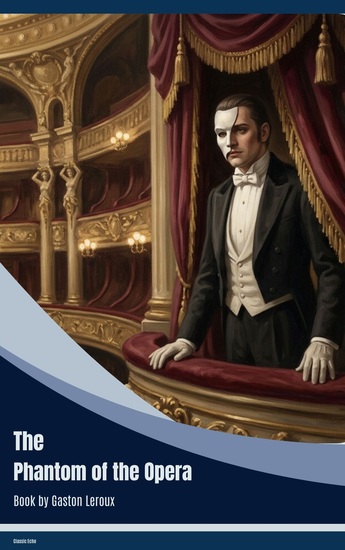
The Phantom of the Opera - cover

The Phantom of the Opera

Gaston Leroux

Publisher: Classic Echo

  • 0
  • 0
  • 0

Summary

Beneath the grandeur of an opera house lies a mystery that refuses to remain hidden.

In The Phantom of the Opera, Gaston Leroux weaves a spellbinding tale of suspense, romance, and Gothic intrigue set within the magnificent halls of the Paris Opera. As unexplained events, whispered legends, and a mysterious masked figure captivate everyone around them, an unforgettable story unfolds—one filled with passion, secrets, and unexpected twists.

Masterfully blending Gothic fiction with psychological suspense and romance, Leroux creates an atmosphere rich with mystery and emotion. His vivid storytelling, unforgettable characters, and elegantly crafted suspense invite readers into a world where beauty, ambition, and obsession collide, making every chapter impossible to put down.

More than a classic mystery, The Phantom of the Opera explores timeless themes of love, loneliness, identity, compassion, and the desire for acceptance. Its emotional depth, haunting atmosphere, and unforgettable setting have made it one of the most beloved novels in world literature.

Celebrated for more than a century, The Phantom of the Opera has inspired iconic stage musicals, acclaimed films, television adaptations, and countless theatrical productions around the world. Gaston Leroux's masterpiece continues to enchant readers with its unforgettable blend of mystery, romance, and Gothic elegance.

Step behind the curtain and uncover one of literature's greatest mysteries. Download The Phantom of the Opera today and experience the timeless classic that has captivated generations of readers.
Available since: 08/07/2026.
Print length: 246 pages.

Other books that might interest you

  • Sahara - cover

    Sahara

    ANGUS BUCHANAN

    • 0
    • 0
    • 0
    SAHARA and EXPLORATION OF AÏR OUT OF THE WORLD NORTH OF NIGERIA by Angus Buchanan are captivating accounts of exploration and adventure. Venture into the heart of the Sahara desert, experience the wonders of Nigeria, and journey through territories untamed by man. Buchanans vivid descriptions and personal narratives provide an engaging firsthand look at these extraordinary expeditions. Ready for an adventure? Embark on a thrilling journey with SAHARA and EXPLORATION OF AÏR OUT OF THE WORLD NORTH OF NIGERIA. Order your copies today!
    Show book
  • Popular Tales - Perrault's Contes Edited by Andrew Lang - cover

    Popular Tales - Perrault's...

    Charles Perrault

    • 0
    • 0
    • 0
    The eight tales Perrault published in 1697 and thereby fixed for Europe: the sleeping beauty, little red riding hood, bluebeard, puss in boots, the fairies, cinderella, ricky of the tuft and hop o' my thumb. He was a senior civil servant and a leader of the moderns in the great literary quarrel; the tales were an argument in it. Each ends in a verse moral, and several of the morals are jokes. Fifty-nine plates of country fairs, gleaners and candlelit interiors by painters from Adam de Coster to Millet carry the peasant world the tales were drawn from.
    Show book
  • The Avenger - A Head-Hunter a Film Studio and Griff Towers - cover

    The Avenger - A Head-Hunter a...

    Edgar Wallace

    • 0
    • 0
    • 0
    A film company on location at Griff Towers, a Sussex country house whose master keeps an ape called Bhag, and a killer the newspapers call the Head Hunter — twelve heads in seven years, each left in a box for the police to find. Wallace was illegitimate, raised by a Billingsgate fish porter and out of school at twelve; at his height a quarter of all books borrowed in England were his, and he could finish a thriller over a long weekend. Fifty-six plates spanning 1863 to 1927, from Munch to Lavery, trace the faces and figures of the era that produced this story of pursuit and notoriety.
    Show book
  • At Christmas Time - From their pens to your ears genius in every story - cover

    At Christmas Time - From their...

    Anton Chekhov

    • 0
    • 0
    • 0
    Anton Pavlovich Chekhov was born on 29th January 1860 in Taganrog, on the south coast of Russia.  
    His family life was difficult; his father was strict and over-bearing but his mother was a passionate story-teller, a subject Chekhov warmed to. As he later said; ‘our talents we got from our father, but our soul from our mother’.  
    At school Chekhov was distinctly average. At 16 his father mis-managed his finances and was declared bankrupt. His family fled to Moscow. Chekhov remained and eked out a living by various means, including writing and selling short sketches to newspapers, to finish his schooling. That completed and with a scholarship to Moscow University obtained he rejoined his family. 
    He was able to help support them by selling satirical sketches and vignettes of Russian lifestyles and gradually obtained further commissions. In 1884, he qualified as a physician and, although it earned him little, he often treated the poor for free, he was fond of saying ‘Medicine is my lawful wife, and literature is my mistress.’ 
    His own health was now an issue as he began to cough up blood, a symptom of tuberculosis.  Despite this his writing success enabled him to move the family into more comfortable accommodation.  
    Chekhov wrote over 500 short stories which included many, many classics including ‘The Kiss’ and ‘The Lady with a Dog’.  His collection ‘At Dusk’ won him the coveted Pushkin Prize when was only 26.  
    He was also a major playwright beginning with the huge success of ‘Ivanov’ in 1887.   
    In 1892 Chekhov bought a country estate north of Moscow. Here his medical skills and money helped the peasants tackle outbreaks of cholera and bouts of famine. He also built three schools, a fire station and a clinic.  It left him with less time for writing but the interactions with real people gained him detailed knowledge about the peasantry and their living conditions for his stories.  
    His most famous work, ‘The Seagull’ was received disastrously at its premiere in St Petersburg. It was later restaged in Moscow to highlight its psychological aspects and was a huge success. It led to ‘Uncle Vanya’, ‘The Three Sisters’ and ‘The Cherry Orchard’.  
    Chekhov suffered a major lung hemorrhage in 1897 while visiting Moscow. A formal diagnosis confirmed tuberculosis and the doctors ordered changes to his lifestyle.  
    Despite a dread of weddings the elusive literary bachelor quietly married the actress Olga Knipper, whom he had met at rehearsals for ‘The Seagull’, on 25th May 1901. 
    By May 1904 with his tuberculosis worsening and death imminent he set off for the German town of Badenweiler writing cheerful, witty letters to his family and assuring them his health was improving.  
    On 15th July 1904 Anton Chekhov died at Badenweiler.  He was 44.
    Show book
  • Ms Found in a Bottle - cover

    Ms Found in a Bottle

    Edgar Allan Poe

    • 0
    • 0
    • 0
    “MS. Found in a Bottle” by Edgar Allan Poe is a haunting tale of maritime terror, mystery, and the unknown. First published in 1833, this classic short story follows a doomed narrator who survives a violent storm only to find himself aboard a ghostly ship crewed by silent, ancient sailors. As the vessel drifts deeper into a strange and otherworldly sea, the narrator records his final observations in a manuscript cast into the ocean. Combining gothic atmosphere, psychological tension, and eerie supernatural elements, Poe’s chilling story remains one of the earliest masterpieces of speculative horror and dark adventure literature. Perfect for readers who enjoy classic gothic fiction, nautical mysteries, and the unsettling imagination of one of America’s greatest literary pioneers.
    Show book
  • Demir-Kaya - From their pens to your ears genius in every story - cover

    Demir-Kaya - From their pens to...

    Alexandr Kuprín

    • 0
    • 0
    • 0
    Alexander Kuprin was born in Narovchat, Penza in Russia on 7th September 1870. 
    At 3 his Father died and he and mother moved to Moscow. By 10 he was enrolled at the Second Moscow Military High School and there his interest in literature began. The Alexander Military Academy followed and two years later he was a sub-lieutenant and posted to an Infantry Regiment for a further four years. 
    Despite his duties he was a now a keen writer and published his first short story at this time. His military duties also garnered him experiences for his breakthrough work ‘The Duel’.  Leaving the military he left for Kiev to work for local newspapers.  He continued to publish both stories and novels and by 1901 he was in St Petersburg becoming part of a group that included Chekhov, Ivan Bunin, Maxim Gorky and Leonid Andreyev.  
    In the years that followed further controversial works and acclaim followed.  His comments on the regime meant he was also put under secret police surveillance.   
    As World War I erupted, Kuprin opened a military hospital but was then given command of an infantry company in Finland. He was soon discharged on grounds of ill health.  
    The October Revolution saw him praise Lenin, but he warned that the Bolsheviks threatened Russian culture and might cause further widespread suffering to the peasants.  As Civil War raged he took his family to Helsinki and then on to Paris. 
    Exile saw his talents decline further and his succumbing to alcoholism. He became lonely and withdrawn. The family's poverty increased his malaise.   
    In May 1937, the Kuprin’s returned to Moscow.  He now saw his work published but wrote almost nothing new.  In 1938 his health rapidly deteriorated.  Already suffering from a kidney problems and sclerosis, he had now developed cancer of the oesophagus.  
    Alexander Kuprin died on 25th August 1938.
    Show book