Rejoignez-nous pour un voyage dans le monde des livres!
Ajouter ce livre à l'électronique
Grey
Ecrivez un nouveau commentaire Default profile 50px
Grey
Abonnez-vous pour lire le livre complet ou lisez les premières pages gratuitement!
All characters reduced
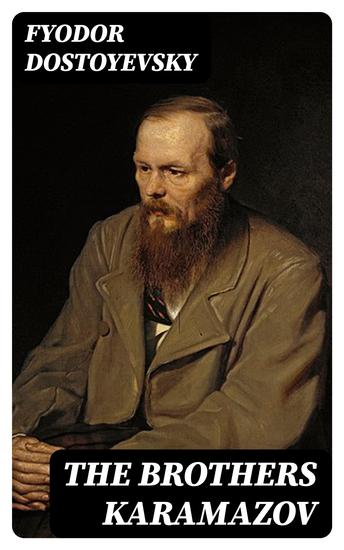
The Brothers Karamazov - cover

The Brothers Karamazov

Fyodor Dostoyevsky

Traducteur Constance Garnett

Maison d'édition: DigiCat

  • 0
  • 0
  • 0

Synopsis

In "The Brothers Karamazov," Fyodor Dostoyevsky masterfully weaves a complex tapestry of philosophical discourse and deep moral inquiry through the narrative of the Karamazov family. Written in a rich, introspective prose style, the novel explores themes of faith, free will, and the nature of evil, set against the backdrop of 19th-century Russian society. Through the struggles of its characters, notably the passionate yet tormented Ivan, the innocent and philosophical Alyosha, and the conflicted Dmitri, the novel delves into existential questions that resonate through time, reflecting Dostoyevsky's own tumultuous relationship with faith and morality amidst the social upheaval of his era. Fyodor Dostoyevsky (1821-1881) was not only a literary giant but also a figure shaped by personal suffering and social critique. His experiences—ranging from his imprisonment in Siberia to grappling with poverty and illness—infused his works with a profound psychological insight. These experiences led him to interrogate the dualities of human nature, which are vividly portrayed in his characters and their philosophical dilemmas. The Karamazov brothers serve as archetypes for the moral battles he perceived in the world around him. Readers are encouraged to engage with "The Brothers Karamazov" for its rich character development and its exploration of enduring philosophical questions. This novel is essential not only for understanding Dostoyevsky's oeuvre but also for anyone seeking profound truths about the human condition, morality, and the quest for meaning in a chaotic world.
Disponible depuis: 13/11/2022.
Longueur d'impression: 838 pages.

D'autres livres qui pourraient vous intéresser

  • The Fortune of the Rougons - cover

    The Fortune of the Rougons

    Émile Zola

    • 0
    • 0
    • 0
    We enter the world of a fictional town of Plassans in Zola's native region of Provence and we are introduced to the eccentric heroine Adelaide Fouque, later known as Tante Dide, who becomes the common ancestor for both the Rougon and Macquart families. Her legitimate son from her short marriage to her late husband, a labourer named Rougon who worked on Dide's land, is forced to grow up alongside two illegitimate children.
    Voir livre
  • 1984 With Full Cast - + Short Stories - cover

    1984 With Full Cast - + Short...

    George Orwell

    • 0
    • 0
    • 0
    George Orwell's novel "1984," published in 1949, stands as a profound and chilling exploration of dystopian society and totalitarianism. Set in a nightmarish future, the story depicts a world dominated by the all-seeing, all-controlling Party led by the enigmatic Big Brother. Orwell's stark portrayal of a society devoid of privacy, individuality, and truth has resonated deeply with readers for decades, making "1984" a timeless work of literature that continues to influence discussions about government control, surveillance, and the nature of truth. 
     
    In the aftermath of World War II, Orwell's "1984" emerged as a powerful cautionary tale, drawing upon the author's own experiences with authoritarian regimes and his concerns about the erosion of individual freedoms. The novel's protagonist, Winston Smith, becomes a symbol of the struggle for independent thought in a world where historical facts are constantly manipulated to serve the Party's narrative. The creation of the Newspeak language, designed to limit freedom of expression, underscores the insidious ways in which totalitarian governments seek to control the minds of their citizens. The harrowing depiction of psychological manipulation, surveillance, and the eradication of dissenting voices paints a stark warning about the dangers of unchecked power. 
     
    The significance of "1984" extends beyond its portrayal of a nightmarish future; it serves as a stark reminder of the fragility of democracy and the importance of safeguarding individual liberties. Orwell's themes of truth, memory, and language resonate with ongoing debates about the role of media, the spread of misinformation, and the erosion of civil liberties in the modern world. As technology continues to advance, the novel's warnings about the potential for mass surveillance and government control remain alarmingly relevant.
    Voir livre
  • A Tragic Actor - cover

    A Tragic Actor

    Anton Chekhov

    • 0
    • 0
    • 0
    "A Tragic Actor" by Anton Chekhov follows the story of Masha, a young and impressionable woman who falls in love with the titular character Fenogenov, a struggling actor. Despite her father's disapproval, Masha decides to run away with Fenogenov and marry him. However, her idealized view of her husband quickly crumbles as she discovers his lack of stability and success. In a desperate moment, Masha must turn to her father for help, leading to a confrontation between father and daughter as well as a reflection on the consequences of following one's heart over practicality. The story highlights themes of love, sacrifice, and the complexities of family relationships.
    Voir livre
  • God Sees the Truth But Waits - From their pens to your ears genius in every story - cover

    God Sees the Truth But Waits -...

    Leo Tolstoy

    • 0
    • 0
    • 0
    Leo Tolstoy was born in 1828 in the Russian province of Tula to a wealthy noble family. As a child, he had private tutors but he showed little interest in any formal education. When he went to the University of Kazan in 1843 to study oriental languages and law, he left without completing his courses.  Life now was relaxed and idle but with some writing also taking place.  Gambling debts forced an abrupt change of path and he joined the army to fight in the Crimean War.  He was commended for his bravery and promoted but was appalled at the brutality and loss of life.  He recorded these and other earlier experiences in his diaries which formed the basis of several of his works. 
    In 1852 ‘Childhood’ was published to immediate success and was followed by ‘Boyhood’ and ‘Youth’. 
    His experience in the army and the horrors he witnessed resulted in ‘The Cossacks’ in 1862 and the trilogy ‘Sevastopol Tales’. After the war he travelled around Europe, visiting London and Paris and meeting such luminaries as Victor Hugo and Charles Darwin.  
    It was now that Tolstoy began his masterpiece, ‘War and Peace’. Published in 1869 it was an epic work that changed literature. He quickly followed this with ‘Anna Karenina’.  
    These successes made Tolstoy rich and helped him accomplish many of his dreams but also brought problems as he grappled with his faith and the lot of the oppressed poor. These revolutionary views became so popular that the authorities now kept him under surveillance.  
    He led a life of asceticism and vegetarianism and put his socialist ideals into practice by establishing numerous schools for the poor and food programmes. He also believed in giving away his wealth, which caused much discord with his wife.  
    His writing continued to bring forth classics such as ‘The Death of Ivan Ilyich’ and many brilliant and incisive short stories such as ‘How Much Land Does A Man Need’.  
    In 1901 Tolstoy was excommunicated from the Church and controversially deselected for the Nobel Prize for Literature. 
    Whilst undertaking a pilgrimage by train in October 1910 with his daughter Aleksandra he caught pneumonia in the nearby town of Astapovo.  Leo Tolstoy died on November 9th, 1910, he was 82.
    Voir livre
  • The History of Rasselas - cover

    The History of Rasselas

    Samuel Johnson

    • 0
    • 0
    • 0
    Above all, Samuel Johnson’s Rasselas (1759) is concerned with the nature of happiness. Rasselas and his companions remove themselves from the pleasure of the ‘happy valley’ so that they can make their ‘choice of life’. In the course of their travels they come across scholars, astronomers, shepherds, hermits and poets, explore their way of life. Rasselas finds that complete happiness is elusive and, in the words of his mentor Imlac, ‘while you are making the choice of life, you neglect to live’.In his treatment of this popular tale from the Orient, Johnson deploys his customary wit and perspicacity. Popular in its own day, Rasselas is a journey of the mind and soul, raising important questions concerning the human condition, which remain pertinent today.
    Voir livre
  • Heart of Darkness - cover

    Heart of Darkness

    Joseph Conrad

    • 0
    • 0
    • 0
    Heart of Darkness tells of the conflicting drives of two men—Charles Marlow, the captain of a steamboat, and Mr. Kurtz, a mysterious figure who oversees a trading post in Africa. After an arduous journey, Marlow finally encounters Kurtz, and the men come to grips with their differences—and their similarities. Joseph Conrad's most famous work is a searing tale of one of the strangest and most memorable voyages ever taken—a journey to the heart of a geographical and psychological wilderness from which no one returns unscarred. For this isn't simply a journey up an uncharted river into a geographical wilderness; rather, it's a trip deep into our collective subconscious.
    Voir livre