Join us on a literary world trip!
Add this book to bookshelf
Grey
Write a new comment Default profile 50px
Grey
Subscribe to read the full book or read the first pages for free!
All characters reduced
The Mystery Of A Hansom Cab - cover

The Mystery Of A Hansom Cab

Fergus Hume

Publisher: Caelwick Press

  • 0
  • 0
  • 0

Summary

We rely on your support to help us keep producing beautiful, free, and unrestricted editions of literature for the digital age. Will you support our efforts with a donation ? The Mystery of a Hansom Cab , published in 1886, was the first novel by Fergus Hume . It begins with a sensational murder, as the body of a dead man is discovered in a hansom cab by the driver. Set in Melbourne, Australia, it presents an engaging story of crime and detection, with several unexpected twists and turns. It also gives a clear and interesting portrait of the colonial city at the peak of its 19th Century prosperity following a gold rush, a time when it was known as "Marvellous Melbourne." The novel contrasts the comfortable lives of the rich and well-connected of the colony with the misery of those living in the noisome slums in the back-streets of the city. The novel, originally published in serial form in a local newspaper, achieved some initial local success when it was first released in book form, but the author then sold the rights to a British company. After warm initial reviews in England The Mystery of a Hansom Cab became not merely a best-seller but what today we would call a "blockbuster" in the United Kingdom, its English-speaking colonies and the United States. It was the best-selling mystery novel of the Victorian era, and apparently was part of the inspiration for Conan Doyle to begin writing his Sherlock Holmes stories. Fergus Hume eventually left Australia and returned to England. Though little-known today, after the success of The Mystery of a Hansom Cab Hume went on to write more than a hundred additional novels in the crime genre, as well as several plays.
Available since: 05/19/2026.
Print length: 303 pages.

Other books that might interest you

  • Eumenides - cover

    Eumenides

    Aeschylus

    • 0
    • 0
    • 0
    The final play of the Oresteia, called The Eumenides (Εὐμενίδες, Eumenídes), illustrates how the sequence of events in the trilogy ends up in the development of social order or a proper judicial system in Athenian society. 
    In this play, Orestes is hunted down and tormented by the Furies, a trio of goddesses known to be the instruments of justice, who are also referred to as the "Gracious Ones" (Eumenides). They relentlessly pursue Orestes for the killing of his mother. However, through the intervention of Apollo, Orestes is able to escape them for a brief moment while they are asleep and head to Athens under the protection of Hermes. Seeing the Furies asleep, Clytemnestra's ghost comes to wake them up to obtain justice on her son Orestes for killing her.
    Show book
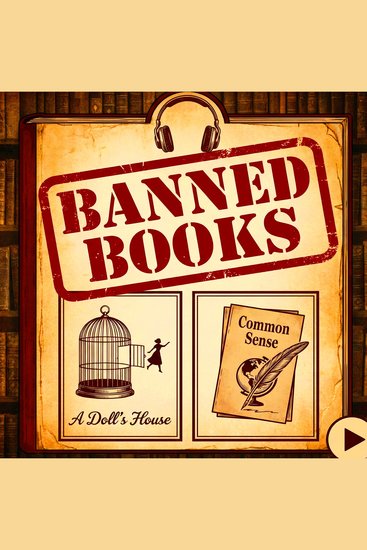
  • Banned Books – A Doll’s House + Common Sense - cover

    Banned Books – A Doll’s House +...

    Henrik Ibsen, Thomas Paine

    • 0
    • 0
    • 0
    Banned Books – A Doll’s House + Common Sense brings together two groundbreaking works that reshaped modern thought, challenged social norms, and sparked cultural revolutions. This dual‑volume release pairs Henrik Ibsen’s iconic drama A Doll’s House with Thomas Paine’s fiery political manifesto Common Sense, offering listeners a powerful journey through ideas that once shook the world. 
     
    In A Doll’s House, Ibsen exposes the constraints placed on women in 19th‑century society through the story of Nora Helmer, a wife and mother who begins to question the roles imposed upon her. The play’s bold critique of marriage, gender expectations, and personal freedom made it one of the most controversial works of its time. 
     
    In Common Sense, Thomas Paine delivers a passionate argument for American independence, written in clear, direct language that ignited a political movement. His call for liberty, self‑governance, and the rejection of monarchy became one of the most influential texts of the American Revolution. 
     
    Together, these works highlight the enduring power of banned and challenged literature — stories and ideas that refuse to remain silent. 
    Perfect for listeners who enjoy classic literature, political philosophy, feminist history, and culturally significant works that continue to inspire debate today.
    Show book
  • The Gift of the Magi - cover

    The Gift of the Magi

    O. Henry

    • 0
    • 0
    • 0
    Sometimes the greatest gifts are the ones given with love and sacrifice.
    
    In The Gift of the Magi, O. Henry tells a touching story of a young couple whose love for each other leads them to make deeply personal sacrifices.
    
    Della and Jim have very little money, but each wants to give the other a meaningful Christmas gift. Determined to express their love despite their financial struggles, they each make a surprising sacrifice for the person they love most.
    
    With warmth, simplicity, and O. Henry's characteristic storytelling, the tale explores the timeless themes of love, generosity, sacrifice, devotion, and selflessness. Its memorable ending delivers the story's central message: the value of a gift is not measured by its price, but by the love and sacrifice behind it.
    
    First published in the early twentieth century, The Gift of the Magi has become one of the most beloved Christmas stories in American literature. Its emotional simplicity and universal message continue to resonate with readers of all ages.
    
    For readers who enjoy classic Christmas stories, romantic fiction, heartwarming short stories, American literature, and timeless tales about love and generosity, this beloved story offers a meaningful and memorable reading experience.
    
    Rediscover the true spirit of giving with O. Henry's beloved Christmas classic. Read The Gift of the Magi today and experience a timeless story of love, sacrifice, generosity, and devotion.
    Show book
  • Don Quixote - cover

    Don Quixote

    Miguel de Cervantes

    • 0
    • 0
    • 0
    Don Quixote has become so entranced by reading romances of chivalry that he determines to become a knight errant and pursue bold adventures, accompanied by his squire, the cunning Sancho Panza. As they roam the world together, the aging Quixote's fancy leads them wildly astray. At the same time the relationship between the two men grows in fascinating subtlety. Often considered to be the first modern novel, Don Quixote is a wonderful burlesque of the popular literature its disordered protagonist is obsessed with.
    Show book
  • The Entail - or The Lairds of Grippy - cover

    The Entail - or The Lairds of...

    John Galt

    • 0
    • 0
    • 0
    A Glasgow merchant entails his estate on the wrong son out of pure obstinacy and destroys three generations doing it. Byron is said to have read it three times, and the Leddy Grippy, the laird's garrulous widow, is one of the great comic figures of Scottish fiction. This edition pairs the novel with a gallery of 55 plates, among them paintings by David Wilkie, Edvard Munch and Thomas Gainsborough, and includes an introduction and glossary.
    Show book
  • Mrs Packletide's Tiger - From their pens to your ears genius in every story - cover

    Mrs Packletide's Tiger - From...

    Saki Saki

    • 0
    • 0
    • 0
    Hector Hugh Munro, more familiarly known by his pen-name ‘Saki’ was born in what was then Akyab in British Burma on 18th December 1870. His father was an Inspector General for the Indian Imperial Police, and his mother the daughter of a Rear Admiral. 
    When he was 2 his mother died and he and his siblings were sent back to England to be raised by their grandmother and paternal maiden aunts in a strict, puritanical household near Barnstaple, Devon. Educated by governesses Saki used many of these women as character models for his later writing. 
    At 17 his father retried and returned to England and then embarked on a series of European travels with Saki and his siblings. 
    After a short stint working in Burma with the Indian Imperial Police Saki decided to move to London to make a living as a writer. Initially he wrote as a journalist for a number of newspapers and magazines before attempting an historical study, ‘The Rise of the Russian Empire’, whose real value lay in directing him to writing short stories instead, the first of which, ‘Dogged’, he published in 1899. 
    From here it was a short stab of the pen to writing political satire before in 1902 he became the foreign correspondent for The Morning Post, first in the Balkans, then Russia, Paris and back to London in 1908, where 'the agreeable life of a man of letters with a brilliant reputation awaited him.'  
    Collections of his short stories full of witty, mischievous and often macabre stories that satirized Edwardian society and two novels now appeared in the years up to the Great War.  At its’ outbreak he was 43 but managed to join as an ordinary trooper. More than once he returned to the battlefield when officially too sick or injured.  
    On 14th November 1916 Hector Hugh Munro was sheltering in crater during the Battle of the Ancre, when he was shot and killed by a German sniper. According to several sources, his last words were "Put that bloody cigarette out!"
    Show book