Rejoignez-nous pour un voyage dans le monde des livres!
Ajouter ce livre à l'électronique
Grey
Ecrivez un nouveau commentaire Default profile 50px
Grey
Abonnez-vous pour lire le livre complet ou lisez les premières pages gratuitement!
All characters reduced
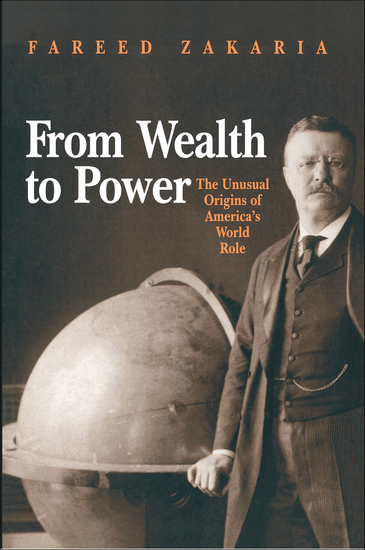
From Wealth to Power - The Unusual Origins of America's World Role - cover

From Wealth to Power - The Unusual Origins of America's World Role

Fareed Zakaria

Maison d'édition: Princeton University Press

  • 0
  • 0
  • 0

Synopsis

"Beautifully conceived; dazzlingly executed . . . The book casts a bright light on the past and the future―and the future of international politics." —Kenneth N. Waltz, Institute of War and Peace Studies, Columbia UniversityIn From Wealth to Power, New York Times-bestselling author Fareed Zakaria examines the most puzzling case of a rising power in modern history—that of the United States.If rich nations routinely become great powers, Zakaria asks, then how do we explain the strange inactivity of the United States in the late nineteenth century? By 1885, the U.S. was the richest country in the world. And yet, by all military, political, and diplomatic measures, it was a minor power. To explain this discrepancy, Zakaria considers a wide variety of cases between 1865 and 1908 when the U.S. considered expanding its influence in such diverse places as Canada, the Dominican Republic, and Iceland. Consistent with the realist theory of international relations, he argues that the President and his administration tried to increase the country's political influence abroad when they saw an increase in the nation's relative economic power. But they frequently had to curtail their plans for expansion, he shows, because they lacked a strong central government that could harness that economic power for the purposes of foreign policy. America was an unusual power--a strong nation with a weak state. It was not until late in the century, when power shifted from states to the federal government and from the legislative to the executive branch, that leaders in Washington could mobilize the nation's resources for international influence.Zakaria's exploration of this tension between national power and state structure will change how we view the emergence of new powers and deepen our understanding of America's exceptional history.
Disponible depuis: 26/07/1999.
Longueur d'impression: 212 pages.

D'autres livres qui pourraient vous intéresser

  • Beneath the Surface of Things - New and Selected Essays - cover

    Beneath the Surface of Things -...

    Wade Davis

    • 0
    • 0
    • 0
    A timely and eclectic collection from one of the foremost thinkers of our time, "a powerful, penetrating and immensely knowledgeable writer" (The Guardian). 


    The essays in this collection came about during the unhurried months when one who had traveled incessantly was obliged to stay still, even as events flared on all sides in a world that never stops moving. Wade Davis brings his unique cultural perspective to such varied topics as the demonization of coca, the sacred plant of the Inca; the Great War and the birth of modernity; the British conquest of Everest; the endless conflict in the Middle East; reaching beyond climate fear and trepidation; on the meaning of the sacred. His essay, "The Unraveling of America," first published in Rolling Stone, attracted five million readers and generated 362 million social media impressions. Media interest in the story was sustained over many weeks, with interview requests coming in from twenty-three countries. 


    The anthropological lens, as Davis demonstrates, reveals what lies beneath the surface of things, allowing us to see, and to seek, the wisdom of the middle way, a perspective of promise and hope that all of the essays in this collection aspire to convey.
    Voir livre
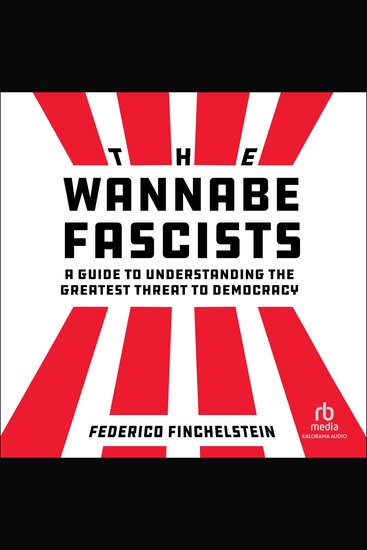
  • The Wannabe Fascists - A Guide to Understanding the Greatest Threat to Democracy - cover

    The Wannabe Fascists - A Guide...

    Federico Finchelstein

    • 0
    • 0
    • 0
    Meet today's almost fascists and learn the warning signs to intercept them on the road from populism to dictatorship. 


    With The Wannabe Fascists, historian Federico Finchelstein offers a precise explanation of why Trumpism and similar movements across the world belong to a new political breed, the last outcome of the combined histories of fascism and populism: the wannabe fascists. This new type of populist politician is typically a legally elected leader who, unlike previous populists who were eager to distance themselves from fascism, turns to totalitarian lies, racism, and illegal means to destroy democracy from within. 


    Drawing on almost three decades of research on the histories of fascism and populism around the world, this book lays out in clear language what the author calls the "four pillars of fascism"—xenophobia, propaganda, political violence, and ultimately dictatorship. Finchelstein carefully explains how and why wannabe fascists like Trump, Bolsonaro, and Modi embrace the first three pillars but don't quite succeed in dictatorship and total suppression of the popular vote. The Wannabe Fascists stresses the importance of preventing despots from reaching this tipping point and offers a clear warning for what's at stake.
    Voir livre
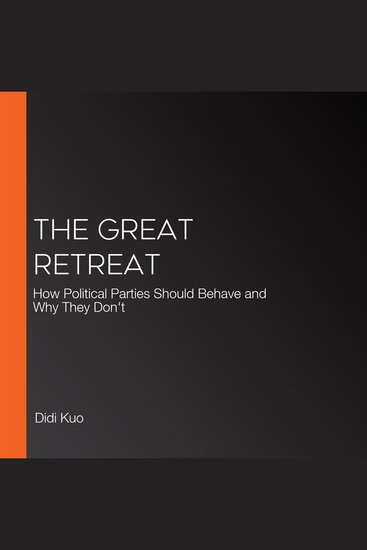
  • The Great Retreat - How Political Parties Should Behave and Why They Don't - cover

    The Great Retreat - How...

    Didi Kuo

    • 0
    • 0
    • 0
    Once a centralizing force of the democratic process, political parties have eroded over the past fifty years. Parties now rank among the most unpopular institutions in society—less trusted than business, the police, and the media. Identification with parties has plummeted, and even those who are loyal to a party report feeling that parties care more about special interests than about regular citizens. What does a "good" political party look like? Why do we urgently need them? And how do we get them? 


    The Great Retreat explores the development of political parties as democracy expanded across the West in the nineteenth century. It focuses in particular on mass parties, and the ways they served as intermediaries that fostered ties between citizens and governments. 


    For democracy to adapt to a new era of global capitalism, Kuo makes the case that we need strong intermediaries like mass parties—socially embedded institutions with deep connections to communities and citizens. Parties are essential to long-term democratic stability and economic growth, while the breakdown of party systems, on the other hand, has historically led to democratic collapse. As trust in political parties has plummeted, The Great Retreat provides a powerful defense of political parties—for without parties, democratic representation is impossible.
    Voir livre
  • Global Warming - The Great Deception - cover

    Global Warming - The Great...

    Guy K Mitchell Jr.

    • 0
    • 0
    • 0
    WALL STREET JOURNAL BESTSELLER 
     
    Global Warming: The Great Deception-The Triumph of Dollars and Politics Over Science and Why You Should Care is the definitive work on the subject of anthropogenic (man-made) global warming. 
     
    Guy Mitchell, a businessman with the mind of a scientist, takes a holistic approach and combines scientific analysis with an in-depth review of the political and economic aspects of the subject. He uses proven science and scientific facts to refute every claim of the climate alarmists and proponents of the man-made global warming hypothesis. He exposes the true reasons that the UN, certain politicians, and global investment firms promote global warming fraud. His analysis is an unbiased, scientifically based, insightful, no-holds-barred approach to the subject. 
     
    Mitchell employs his keen sense of business acumen to expose the real drivers behind the claims of man-made global warming: research funding, politics, and global economics. Over $1 trillion worldwide has been spent on global warming research with nothing of substance to show for it. Certain politicians in the US and Western Europe embrace the fraudulent hypothesis with no apparent understanding of the science or the socioeconomic impact that the abandonment of fossil fuels would have on the world economy or the reliability of the power grids that drive it. 
     
    Why do the U.N. and certain politicians in the U.S. and Western Europe continue to promote the fraudulent global warming hypothesis? It is all about the money - money for research and to affect socio-economic change. For many politicians, it is all about the power - the power to control the lives of the electorate. Power is the ultimate narcotic. And money follows power in politics.
    Voir livre
  • David Trimble: Peacemaker - cover

    David Trimble: Peacemaker

    Stephen Walker

    • 1
    • 0
    • 0
    Nobel laureate, party leader, peacemaker, first minister and statesman – David Trimble had many roles. But what is the real story behind the man who made headlines and changed lives?
    In this definitive biography of Trimble's life and death, award-winning journalist Stephen Walker vividly details how a shy Belfast academic changed the political landscape of Northern Ireland.
    Written with the cooperation of his widow, Lady Trimble, and their grown-up children, Peacemaker offers unparalleled insights into the life of the first person to be elected first minister of Northern Ireland and the most significant unionist leader since the creation of Northern Ireland in 1921. From the beginning of his political career in the dark days of the Troubles, to bringing unionism and nationalism together to end decades of division and violence and secure peace, Trimble's personal journey mirrors the story of Northern Ireland itself.
    Drawing on over 100 fresh interviews, this is a colourful and personal account of the life of a key figure in Irish history and an essential companion to Stephen Walker's bestselling biography of John Hume.
    Voir livre
  • Crossing the Line - Finding America in the Borderlands - cover

    Crossing the Line - Finding...

    Sarah Towle

    • 0
    • 0
    • 0
    It was family separation and “kids in cages” that drove Sarah Towle to the U.S. southern border. On discovering the many-headed hydra that is the U.S. immigration system—and the heroic determination of those caught under its knee—she could never look away again. Crossing the Line: Finding America in the Borderlands charts Sarah’s journey from outrage to activism to abolition as she exposes, layer by “broken” layer, the global deterrence to detention to deportation complex that is failing everyone—save the profiteers and demagogues who benefit from it. 
    Deftly weaving together oral storytelling, history, and memoir, Sarah illustrates how the U.S. has led the retreat from post-WWII commitments to protecting human rights. Yet within the web of normalized cruelty, she finds hope and inspiration in the extraordinary acts of ordinary people who prove, every day, there is a better way. By amplifying their voices and celebrating their efforts, Sarah reveals that we can welcome with dignity those most in need of safety and compassion. In unmasking the real root causes of the so-called “crisis” in human migration, she urges us to act before we travel much farther down our current course—one which history will not soon forgive, or forget.
    Voir livre