Join us on a literary world trip!
Add this book to bookshelf
Grey
Write a new comment Default profile 50px
Grey
Subscribe to read the full book or read the first pages for free!
All characters reduced
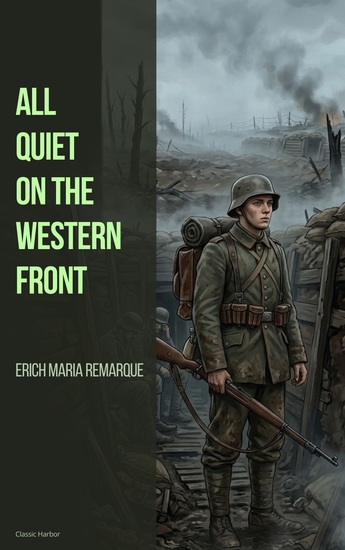
All Quiet on the Western Front - cover

All Quiet on the Western Front

Erich Maria Remarque

Translator A. W. Wheen

Publisher: Classic Harbor

  • 0
  • 0
  • 0

Summary

Experience the harsh realities of war through the eyes of young soldiers whose lives are changed forever.

Erich Maria Remarque's All Quiet on the Western Front presents a powerful and deeply human portrayal of soldiers during the First World War.

Through the experiences of young men serving on the Western Front, the novel explores friendship, fear, survival, loss, and the devastating effects of combat. Remarque focuses on the human cost of war and the distance between patriotic ideals and the realities faced by those on the battlefield.

First published in 1929, the novel became an internationally recognized work of anti-war literature and remains an important classic of twentieth-century fiction.

Discover a moving literary portrait of war, friendship, and the human struggle for survival.
Available since: 09/21/2026.
Print length: 202 pages.


Other books that might interest you

  • Pioneers of Industry – 10 Business Visionaries in 5 Minutes - Quick Biographies of the World's Most Influential Figures - cover

    Pioneers of Industry – 10...

    5 Minutes, 5 Minute Biographies,...

    • 0
    • 0
    • 0
    Whether you're commuting, relaxing, or curious to learn something new:These short, vivid biographies offer quick insights, big ideas, and timeless inspiration. Who built the modern world? Discover the entrepreneurs, inventors, and trailblazers behind global brands and bold ideas – in quick, inspiring audio portraits. Cornelius Vanderbilt, John P. Morgan, John D. Rockefeller, Henry Heinz, Col. Harland Sanders, Ray Kroc or Steve Jobs: 10 smart, engaging, and easy to follow biographies – history has never sounded this good.
    Show book
  • You Can't Say That!: - The demise of free thought in Australia - cover

    You Can't Say That!: - The...

    Melinda Richards

    • 0
    • 0
    • 0
    This book is about freedom and the right to have an opinion. A concept that has been fought over for centuries. Whilst we think of Australia as being a free society, You Can't Say That! challenges this notion, arguing that the freedoms all Australians once enjoyed have been systematically eroded over last few decades, and how, as a nation, we must fight to get them back.Let this book guide you to a place where you ask:   • Who are my masters?   • How much do I desire to fit into the current trend of "progressive" thought and "woke" ideas which are fast becoming societal norms?   • How far am I willing to go to accept the current trends of collectivism, conformity, hypocrisy and cancel culture?The Purpose of You Can't Say That! is to encourage discussion and debate in the current stifling politically correct environment, as well as providing a platform for those fighting to gain back their basic rights for freedom of speech.If you are tired of the opinions of elitist bullies telling you what you must say and think, taking over all debates in the mainstream media and within our institutions, then you can read this book and feel empowered that you in fact CAN say that.
    Show book
  • Successful Introvert in Extroverted World - Complete guide for introverts who want to make friends be social and build leadership abilities and developing powerful skills - cover

    Successful Introvert in...

    Brian Gibson

    • 0
    • 0
    • 0
    This audiobook is narrated by an AI Voice. We often seem to be living in an extroverted world—it is the route to attention. We teach our children to speak up, not be shy, and encourage them to be bold. Even our parents would tell us that “the squeaky wheel gets the oil!” The media tells us that the person willing to be the loudest will win the reality show, get the recording contract, get hits on YouTube… Growing up, we were encouraged to find our voice, choose a research area, and set the framework for a lifetime profession. 
    Many claims that Americans live in an “extroverted society” that rewards extroverted behavior and rejects introversion. This is because the United States is currently a culture of personality, whereas other cultures are cultures of character. Being an introvert in an extrovert’s world is doable—maybe even pleasant. And maybe the world does not truly belong to one or the other, but to the symbiosis between the two. The most important point to remember is that both types are equally important in their worth and contributions to society. Introverts should not be viewed as the “underdog” or disadvantaged because they are less outgoing or verbal. We have all heard of famous introverts such as Bill Gates, Steven Spielberg, J. K. Rowling, Albert Einstein, Jane Austen, Thomas Jefferson, and Mahatma Gandhi, individuals who, through their quiet ways, have made a tremendous impact on human culture. 
    In this book, you will learn all about introverted and extroverted personalities, the right way to communicate, and the solutions to success today.
    Show book
  • End of the Bronze Age The: The History of the Kingdoms that Dominated the Near East in the Late Bronze Age - cover

    End of the Bronze Age The: The...

    Charles River Editors

    • 0
    • 0
    • 0
    When scholars look at the passage of history, certain epochs and transitions to new periods tend to stand out. The transition from the early modern to the Industrial Age in the late 18th century and the collapse of the Roman Empire are two of the more well known, but the transition from the Bronze to the Iron Age during the late 13th and early 12th centuries BCE arguably changed the structure and course of world history more fundamentally than any period before or since. During this period, numerous wealthy and enduring kingdoms of the eastern Mediterranean Sea region collapsed, and new ones rose in their places.  
    At the center of this period of turmoil was a group of people known today as the Sea Peoples, the English translation of the name given to them by the Egyptians. Despite their prominent role in history, however, the Sea Peoples remain as mysterious as they were influential; while the Egyptians documented their presence and the wars against them, it has never been clear exactly where the Sea Peoples originated from, or what compelled them to invade various parts of the region with massive numbers. Whatever the reason, the Sea Peoples posed an existential threat to the people already living in the region. 
    	Naturally, the mystery surrounding the Sea Peoples has led to all kinds of theories aiming to identify them. While plenty of theories are plausible, there are other fanciful theories that have attempted to associate the Sea Peoples with the Atlantic Ocean and even Troy.
    Show book
  • Early America’s Most Important Expeditions: The History of the Lewis and Clark Expedition and Zebulon Pike’s Expeditions - cover

    Early America’s Most Important...

    Editors Charles River

    • 0
    • 0
    • 0
    Throughout his presidency at the beginning of the 19th century, Thomas Jefferson had worried about the future of the western U.S., seeing that settlements in the Ohio Valley and lower South relied upon the Mississippi River. France’s controls over the region, in his estimation, put the U.S. at a severe disadvantage. His solution proved successful beyond his wildest imagination, for Napoleon did not only sell New Orleans to the U.S, the portion that Jefferson instructed his ministers to make an offer on, but all of “New France,” the entire area of Louisiana. Jefferson might have said later that his purchase of the territory “strained” but did not “break” the Constitution, but also should have boasted that, with one stroke, he had removed one less obstacle to American expansionism. The Louisiana Purchase encompassed all or part of 15 current U.S. states and two Canadian provinces, and it allowed Jefferson to plan something he had talked about since taking office: an expedition deep into the unmapped and largely unknown continent with the final destination being the Pacific Ocean. This could prove the most significant of the goals that Jefferson - a person who thought of himself as a scientifically-minded thinker - wanted to accomplish as president. 
    	In the aftermath of the Louisiana Purchase, the Lewis and Clark expedition was a much-heralded blow for American rights in the face of international competition, but that was only one of four expeditions authorized by Jefferson. Four years before Lewis and Clark set off, an army officer from New Jersey led two long-distance treks, one northward to the headwaters of the Mississippi River and the other to the Southwest. These were the only expeditions authorized by Jefferson while they were already en route, planned and launched by subordinates within the military. Indeed, the career of Zebulon Pike was “dominated by ambiguously motivated explorations of the American West.”
    Show book
  • You Think You’re Healing? - The Uncomfortable Truth About Why You Know Exactly What Hurts And Still Choose It Anyway - cover

    You Think You’re Healing? - The...

    Hamza Zaid

    • 0
    • 0
    • 0
    What if the hardest part of healing isn’t letting go of other people, but letting go of the version of yourself that keeps choosing what hurts? 
    You Think You’re Healing? is an honest, thought-provoking look at the patterns we repeat, the excuses we tell ourselves, and the uncomfortable truths we often avoid. Through powerful insights and relatable examples, Hamza Zaid challenges readers to stop confusing familiarity with love, self-sacrifice with healing, and survival with growth. 
    This isn’t a book that promises easy answers. It’s a book that asks the questions you’ve been avoiding, so you can finally stop choosing what keeps breaking you.
    Show book