Unisciti a noi in un viaggio nel mondo dei libri!
Aggiungi questo libro allo scaffale
Grey
Scrivi un nuovo commento Default profile 50px
Grey
Iscriviti per leggere l'intero libro o leggi le prime pagine gratuitamente!
All characters reduced
The collected stories of Elisabeth Sanxay Holding - cover

The collected stories of Elisabeth Sanxay Holding

Elizabeth Sanxay Holding

Casa editrice: Good Press

  • 0
  • 0
  • 0

Sinossi

In 'The Collected Stories of Elisabeth Sanxay Holding,' readers are invited into a diverse array of narrative worlds where psychological tension and incisive character studies reign supreme. Holding, masterfully weaving elements of mystery and suspense, captivates her audience with tightly constructed tales that often reveal the darker aspects of human nature. With a prose style marked by clarity and psychological depth, her storytelling reflects the influences of early 20th-century American literature, echoing the complexities found in the works of contemporaries such as Patricia Highsmith and Shirley Jackson. This collection stands as a testament to Holding's craftsmanship, showcasing her unique approach to suspense rooted in domestic settings that illuminate social anxieties of her time. Elisabeth Sanxay Holding emerged as a significant figure in American literature, particularly as a pioneering voice in the fields of mystery and crime fiction. Her background as a novelist and a short story writer, intertwined with her experiences during the socio-cultural transformations of the 1930s and 1940s, provided her with a keen insight into human psychology and societal dynamics. This contextual foundation informed her writing, allowing her to explore themes of morality, betrayal, and the emotional undercurrents of seemingly mundane lives. Readers who appreciate layered narratives rich in psychological nuance will find 'The Collected Stories of Elisabeth Sanxay Holding' not only an enchanting journey but also an essential exploration of the human condition. This volume serves as an entrancing introduction to Holding's oeuvre, appealing to both seasoned enthusiasts of classic literature and modern readers seeking to unravel the intricate tapestry of her storytelling.
Disponibile da: 24/04/2025.
Lunghezza di stampa: 200 pagine.

Altri libri che potrebbero interessarti

  • Rudyard Kipling - Chapter & Verse - Poetry and prose together from literary greats - cover

    Rudyard Kipling - Chapter &...

    Rudyard Kipling

    • 0
    • 0
    • 0
    Literature is a world of words and wonder, able to take us on almost unimaginable journeys from the wild and fantastic to the grind and minutiae of life. 
     
    An author’s ideas are his building blocks, his architecture of the mind, building a structure on which all else will rest; the narrative, the characters, the words - those few words that begin the adventure. 
     
    In this series we look at some of our leading classic authors across two genres: the short story and the poem.  In this modern world there is an insatiable need to categorise and pigeon-hole everyone and everything.  But ideas, these grains and saplings of the brain, need to roam, to explore and find their perfect literary use vehicle.  Our authors are masters of many literary forms, perhaps known for one but themselves favouring another. 
     
    Story. Poems. Story.  Within these boundaries come all manner of invention and cast of characters.  And, of course, each author has their own way of revealing their own chapter and verse.    
     
    1 - Chapter & Verse - Rudyard Kipling - An Introduction 
    2 - Mark of the Beast by Rudyard Kipling 
    3 - If by Rudyard Kipling 
    4 - My Father's Chair by Rudyard Kipling 
    5 - My Boy Jack by Rudyard Kipling 
    6 - Mother O' Mine by Rudyard Kipling 
    7 - A Death Bed by Rudyard Kipling 
    8 - The English Flag by Rudyard Kipling 
    9 - Tommy by Rudyard Kipling 
    10 - Mandalay by Rudyard Kipling 
    11 - In Springtime by Rudyard Kipling 
    12 - To the City of Bombay by Rudyard Kipling 
    13 - Cities and Thrones and Powers by Rudyard Kipling 
    14 - The Prairie by Rudyard Kipling 
    15 - The Way Through the Woods by Rudyard Kipling 
    16 - Mary Postgate by Rudyard Kipling
    Mostra libro
  • Dwellings of the Damned - 15 Haunted House Stories - cover

    Dwellings of the Damned - 15...

    Robert Arthur, E.F. Benson, A....

    • 0
    • 0
    • 0
    A collection of stories concerning shunned and disreputable houses. 
    Contents: 
    Nobody's House by A. M. Burrage (1927) 
    The history of a haunted house. 
    A Night of Horror by Dick Donovan (1899) 
    A haunted castle in the hills of Wales. 
    The Room in the Tower by E. F. Benson (1912) 
    A recurring nightmare. 
    The House of the Nightmare by Edward Lucas White (1906) 
    A night at a remote country house. 
    The Shunned House by H. P. Lovecraft (1937) 
    An abandoned house in Providence. 
    The Red Lodge by H. Russell Wakefield (1928) 
    A dreadful rental experience. 
    The Specter Priestess of Wrightstone by Herman F. Wright (1925) 
    A legend surrounding an English castle. 
    The Secret of the Vault by J. Wesley Rosenquest (1938) 
    A charnel chamber beneath an old house. 
    Black Was the Night by Laurence Bour, Jr. (1940) 
    An encounter in a crumbling house. 
    Six Flights to Terror by Manly Banister (1946) 
    How do you bury a building? 
    Up Under the Roof by M. W. Wellman (1938) 
    Something stalks the space between the roof-peak and the ceiling. 
    The Believers by Robert Arthur (1941) 
    A radio host broadcasts from a crumbling, haunted mansion. 
    Pigeons from Hell by Robert E. Howard (1938) 
    A deserted plantation mansion haunted by ghostly pigeons. 
    The Ghost of a Hand by Sheridan Le Fanu (1863) 
    A house haunted by a partially visible ghost. 
    Dark Mummery by Thorp McClusky (1944) 
    Beware of 'reputedly' haunted houses.
    Mostra libro
  • Sarajevo Marlboro - cover

    Sarajevo Marlboro

    Miljenko Jergović

    • 0
    • 0
    • 0
    Miljenko Jergović’s landmark collection of stories, Sarajevo Marlboro, set during the siege of Sarajevo, provides a deeply personal perspective on the lives of ordinary people trapped in extraordinary circumstances. At the same time, it offers profound insight into the universality of wartime suffering. 
    A native of Sarajevo, Jergović worked as a journalist for the weekly newspaper Nedjeljna Dalmacija, reporting from the besieged city during the Bosnian War, where he also served as a television editor. He witnessed moments of love, loss, and hope that transcended the surrounding violence. Against the backdrop of a war-torn city, these stories capture the resilience of everyday life. Each tale is a gem, rich with vivid details and unforgettable characters who linger in the reader’s mind long after the final page. Sarajevo Marlboro earned Jergović international acclaim and several prestigious awards, including the Erich Maria Remarque Peace Prize and the Ksaver Šandor Gjalski Award. 
    A tremendous volume; everybody should read it. “The Gardener” is one of the best stories I’ve ever read, but there are so many gems here — approachable, readable, witty, open, devastating. - John Darnielle, The Mountain Goats 
    Miljenko Jergović is a renowned Bosnian and Croatian writer, journalist, and publicist, recognized as one of the most prominent authors of the post-Yugoslav era, with acclaim extending beyond his native language. His works have been widely translated, receiving numerous domestic and international literary awards, solidifying his reputation as a leading voice in contemporary literature. He lives and works in Zagreb, Croatia. 
    Publication of this audiobook was cofunded by the Ministry of Culture and Media of the Republic of Croatia.
    Mostra libro
  • Whose Body? - The Lord Peter Wimsey Mysteries Vol: 1 - cover

    Whose Body? - The Lord Peter...

    Dorothy L. Sayers

    • 0
    • 0
    • 0
    Lord Peter Wimsey investigates the sudden appearance of a naked body in the bath of an architect at the same time a noted financier goes missing under strange circumstances. As the case progresses it becomes clear that the two events are linked in some way.
    Mostra libro
  • The Jew - Turgenev's heartbreaking story gives us a rare insight into anti-semitism in Russian society - cover

    The Jew - Turgenev's...

    Ivan Turgenev

    • 0
    • 0
    • 0
    Ivan Sergeyevich Turgenev was born on 9th November 1818 in Oryol, Russia to parents from the nobility.  He and his two brothers were raised by their mother on the family estate.  Surrounded by foreign governesses he became fluent in French, German, and English.  Their father spent little time with them and this undoubtedly had an effect on him and his brothers.  When he was nine the family moved to Moscow to give their children a better education. 
     
    Turgenev studied for a year at the University of Moscow and then at the University of St Petersburg to study Classics, Russian literature, and philology.  During that time his father died from kidney stone disease.  In 1838 Turgenev studied philosophy and history at the University of Berlin for 3 years before returning to St Petersburg for his master's. 
     
    He started his career with the Russian Civil Service and it was only in 1852, after several earlier publications, that he made his name with his short story collection, ‘A Sportsman's Sketches’, based on his observations of peasant life and nature. 
      
    That same year he wrote an obituary for Nikolai Gogol: "Gogol is dead!... What Russian heart is not shaken by those three words?... He is gone, that man whom we now have the right (the bitter right, given to us by death) to call great."  The St Petersburg censor banned publication but the Moscow censor allowed it.  He was dismissed but Turgenev was held responsible and imprisoned for a month, and then exiled to his country estate.  
     
    Along with many other intellectuals Turgenev left Russia and settled in Paris in 1854.  During this period he wrote his finest stories and four novels.  
     
    Alexander II ascended the Russian throne in 1855, and the political climate relaxed.  Turgenev returned home.  
     
    ‘Fathers and Sons’, Turgenev's most famous and enduring novel, appeared in 1862. Its leading character is considered the first ‘Bolshevik’ in Russian literature. But the hostile reaction prompted Turgenev's decision to again leave Russia.  
     
    His health declined during his later years.  In January 1883, an aggressive malignant tumor was removed but by then it had metastasized in his upper spinal cord, causing him intense pain in his final few months of life.  
     
    Ivan Turgenev died on 3rd September 1883 of a spinal abscess, a complication of the metastatic liposarcoma, in his house near Paris.  He was buried in St Petersburg.  
     
    In ‘The Jew’ Turgenev explores a subject that is often treated abrasively by Russian authors.  In this heartbreaking tale an officer is begged by a Jew to help him.  He is even prepared to offer, with tragic consequences, a young girl as part of the bargain.
    Mostra libro
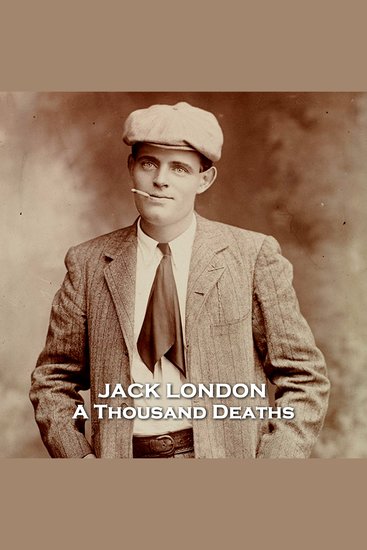
  • A Thousand Deaths - From their pens to your ears genius in every story - cover

    A Thousand Deaths - From their...

    Jack London

    • 0
    • 0
    • 0
    John Griffith Chaney was born on January 12th, 1876 in San Francisco.   
    His father, William Chaney, was living with Flora Wellman when she became pregnant.  Chaney insisted she have an abortion.  Flora's response was to turn a gun on herself.  Although her wounds were not severe the trauma made her temporarily deranged. 
    In late 1876 his mother married John London and the young child was brought to live with them as they moved around the Bay area, eventually settling in Oakland where now, calling himself Jack, he completed grade school. 
    Jack worked hard at several jobs, sometimes 12-18 hours a day, but his dream was university.  He studied hard and borrowed the money to enrol in the summer of 1896 at the University of California in Berkeley. 
    In 1897, at 21, Jack searched out newspaper accounts of his mother's suicide attempt and for the name of his biological father. He wrote to Chaney, then living in Chicago, who claimed he could not be Jack’s father because he was impotent and casually asserted that London's mother had relations with other men.  Jack, devastated by the response, quit Berkeley and went to the Klondike. Other accounts suggest that his dire finances presented Jack with the excuse he needed to leave. 
    In the Klondike Jack began to gather material for his writing but also accumulated many health problems, including scurvy, which together with hip and leg problems he would carry for the rest of his life. 
    During the late 1890's Jack was regularly publishing short stories and by the turn of the century full blown novels. 
    By 1904 Jack had married, fathered two children and was now in the process of divorcing.  A stint as a reporter on the Russo-Japanese war of 1904 was equal amounts trouble and experience. But that experience was always put to good use in a continuing and remarkable output of work. 
    In 1905 he married Charmian Kittredge who at last was a soul and companion who brought him some semblance of peace despite his advancing alcoholism and his incurable wanderlust. 
    Twelve years later Jack had amassed both wealth and a literary reputation through such classics as ‘The Call of the Wild’, ‘White Fang’ and many others. He had a reputation as a social activist and was a tireless friend of the workers.   
    Jack London died suffering from dysentery, late-stage alcoholism and uremia, aged only 40, on November 22nd 1916 at his property in Glen Elen in California.
    Mostra libro