Join us on a literary world trip!
Add this book to bookshelf
Grey
Write a new comment Default profile 50px
Grey
Subscribe to read the full book or read the first pages for free!
All characters reduced
The Yellow Crayon - A Secret Society in Two Continents - cover

The Yellow Crayon - A Secret Society in Two Continents

E. Phillips Oppenheim

Publisher: Aeneas Press

  • 0
  • 0
  • 0

Summary

Mr. Sabin, once the most dangerous intriguer in Europe, is living quietly in America with his wife Lucille when a summons reaches her at the Waldorf-Astoria from the secret society she once pledged herself to — and Sabin must fight it across two continents to keep her. Oppenheim kept his father's leather books for twenty years and wrote at night, then produced some hundred and fifteen novels of embassies, sleeping cars and men who are never quite what their passports say — the man who invented the modern thriller's furniture. Fifty-nine plates of harbour fog and lamplit waterfront by Whistler and Grimshaw run through the book like the mist and night in which Sabin's pursuit is conducted.
Available since: 08/19/2026.
Print length: 229 pages.

Other books that might interest you

  • Notes from the Underground - A Confession from a Petersburg Corner - cover

    Notes from the Underground - A...

    Fyodor Dostoevsky

    • 0
    • 0
    • 0
    A retired civil servant lives in a corner of Petersburg and addresses the reader with forty pages of argument nobody asked for: that reason will not make men good, that a man may choose his own harm simply to prove he is free. Then he tells the story that proves it. Dostoevsky wrote it after prison and exile, and everything he built afterwards stands on this small furious book. Sixty plates of boulevard idlers, reading rooms and dim interiors by Vladimir Makovsky and Aleksander Gierymski set the Petersburg of the confession beside the wider nineteenth century.
    Show book
  • An Outcast of the Islands - cover

    An Outcast of the Islands

    Joseph Conrad

    • 0
    • 0
    • 0
    "An Outcast of the Islands" by Joseph Conrad is a powerful and unsettling novel that delves deep into the human psyche, exploring themes of exile, moral failure, and the destructive force of unchecked desire. Set in the lush yet unforgiving world of the Malay Archipelago, the story continues Conrad's exploration of colonial life and its corrosive effects on both individuals and cultures.
    
    The novel follows Peter Willems, a disgraced European trader who is cast out of colonial society after a series of ethical and personal failures. Seeking refuge, Willems is taken in by a native ruler, where he attempts to rebuild his status through manipulation and ambition. His inner weaknesses—pride, greed, and self-deception—ultimately drive him toward betrayal and moral collapse.
    
    Through Willems's tragic journey, Conrad exposes the fragility of civilization and the illusions of superiority held by colonial powers. The tropical setting, vividly rendered and morally charged, serves as both backdrop and catalyst for the characters' inner conflicts. Indigenous cultures are portrayed with complexity, highlighting the tensions and misunderstandings that arise when worlds collide.
    
    Dark, introspective, and psychologically intense, An Outcast of the Islands examines the consequences of isolation and the cost of moral compromise. Conrad's nuanced prose and unflinching analysis of character foreshadow the themes that would define his later masterpieces, including alienation, guilt, and the struggle between conscience and desire.
    
    A compelling work of literary fiction, An Outcast of the Islands is essential reading for those interested in classic literature, psychological novels, and Conrad's profound critique of imperialism and human weakness.
    Show book
  • Strange Case of Dr Jekyll and Mr Hyde - cover

    Strange Case of Dr Jekyll and Mr...

    Robert Louis Stevenson

    • 0
    • 0
    • 0
    A respected doctor hides a terrifying secret that challenges everything his friends believe about human nature.
    
    Robert Louis Stevenson's The Strange Case of Dr. Jekyll and Mr. Hyde follows Dr. Henry Jekyll, a respected London physician whose mysterious connection to the sinister Edward Hyde gradually becomes the center of a disturbing mystery.
    
    As strange events unfold, the story explores the conflict between morality and desire, reputation and secrecy, and the opposing sides of human nature.
    
    Combining Gothic horror, mystery, psychological drama, and suspense, Stevenson's novella has become one of the most enduring explorations of the darker side of humanity.
    
    Uncover the mystery of Dr. Jekyll and Mr. Hyde and discover a timeless Gothic classic about the hidden forces within us.
    Show book
  • Baby Mine - A Farce of Married Life - cover

    Baby Mine - A Farce of Married Life

    Margaret Mayo

    • 0
    • 0
    • 0
    A young wife, caught in a lie, tells her husband she has had a baby — and then has to produce one, at short notice, in a New York flat, with the help of a friend and a series of borrowed infants. Mayo was an actress who turned playwright and gave Broadway one of its most durable farces; the mechanics are ruthless, and it was filmed twice. Fifty-seven plates of painting from 1895 to 1928, among them Gibson's studies in expression and Shinn's Keith's Union Square, catch the New York comedy of manners this farce depends on.
    Show book
  • The Emperor's New Clothes - cover

    The Emperor's New Clothes

    Hans Christian Andersen

    • 0
    • 0
    • 0
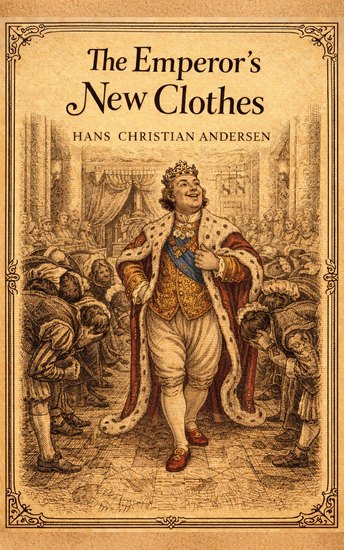
    Step into a world of vanity, deception, and surprising courage in Hans Christian Andersen's timeless classic, The Emperor's New Clothes. This beloved fairy tale tells the story of a proud and fashion-obsessed emperor who cares for little beyond his extravagant wardrobe and public image. When two cunning swindlers arrive at his court claiming they can weave the most magnificent fabric ever seen—one invisible to anyone unfit for their position or hopelessly foolish—the emperor eagerly commissions a royal suit.
    
    As the "magical" cloth is crafted, ministers and officials are sent to inspect the progress. Afraid of appearing incompetent or foolish, each one pretends to see the nonexistent fabric, praising its beauty and sophistication. The emperor himself, unwilling to admit he sees nothing, joins in the charade. Soon, the entire kingdom buzzes with admiration for a suit that does not exist.
    
    On the day of the grand procession, the emperor proudly parades through the streets wearing his "new clothes," while his subjects, equally fearful of exposing themselves as unworthy, applaud in false admiration. It is only when a small child, innocent and unafraid of judgment, speaks the simple truth—"But he isn't wearing anything at all!"—that the illusion is shattered.
    
    With humor, wit, and sharp social commentary, Andersen's tale explores themes of pride, conformity, honesty, and the power of truth. Beneath its playful storytelling lies a profound message about the dangers of vanity and the human tendency to follow the crowd rather than trust one's own judgment.
    
    The Emperor's New Clothes remains a powerful and relevant story for readers of all ages, reminding us that courage often comes from the most unexpected voices—and that sometimes, the simplest truth is the hardest to admit.
    Show book

  • Afterward - cover

    Afterward

    Edith Wharton

    • 0
    • 0
    • 0
    "Afterward" is a short story by American writer Edith Wharton. It was first published in the 1910 edition of The Century Magazine and later reprinted in her books The Collected Short Stories of Edith Wharton and Tales of Men and Ghosts. This intriguing tale weaves an ironic ghost story around themes of greed and retribution.
    Show book