Unisciti a noi in un viaggio nel mondo dei libri!
Aggiungi questo libro allo scaffale
Grey
Scrivi un nuovo commento Default profile 50px
Grey
Iscriviti per leggere l'intero libro o leggi le prime pagine gratuitamente!
All characters reduced
John Halifax Gentleman - cover

John Halifax Gentleman

Dinah Maria Mulock Craik

Casa editrice: DigiCat

  • 0
  • 0
  • 0

Sinossi

In 'John Halifax, Gentleman,' Dinah Maria Mulock Craik presents a compelling narrative set in Victorian England that intricately explores themes of social class, identity, and moral integrity. Through the life of John Halifax, a self-made man whose journeys oscillate between humble beginnings and genteel society, Craik employs a rich, descriptive prose that captures the ethos of the era. The novel's literary style resonates with the didactic tendencies of Victorian literature, offering readers a moral compass while navigating through personal and societal challenges, ultimately advocating for kindness and integrity amidst adversity. Dinah Maria Mulock Craik, a prominent figure in the Victorian literary scene, was motivated by her own experiences of poverty and social mobility, insights that deeply influenced her thematic choices in 'John Halifax, Gentleman.' Her background allowed her to portray the struggles and triumphs of the working class authentically, evoking empathy in her readership. Craik was not only a novelist but also a poet and a feminist, and her desire to highlight the strength of the human spirit is omnipresent throughout her writing. This timeless novel is highly recommended for readers interested in 19th-century literature, social commentary, or character-driven stories. Craik's intricate character development and vivid depictions of Victorian life offer treasures for both literary enthusiasts and casual readers alike. 'John Halifax, Gentleman' stands as a testament to personal dignity and social responsibility, making it a must-read for those seeking both entertainment and enlightenment.
Disponibile da: 04/09/2022.
Lunghezza di stampa: 431 pagine.

Altri libri che potrebbero interessarti

  • A Chameleon - From their pens to your ears genius in every story - cover

    A Chameleon - From their pens to...

    Anton Chekhov

    • 0
    • 0
    • 0
    Anton Pavlovich Chekhov was born on 29th January 1860 in Taganrog, on the south coast of Russia.  
    His family life was difficult; his father was strict and over-bearing but his mother was a passionate story-teller, a subject Chekhov warmed to. As he later said; ‘our talents we got from our father, but our soul from our mother’.  
    At school Chekhov was distinctly average. At 16 his father mis-managed his finances and was declared bankrupt. His family fled to Moscow. Chekhov remained and eked out a living by various means, including writing and selling short sketches to newspapers, to finish his schooling. That completed and with a scholarship to Moscow University obtained he rejoined his family. 
    He was able to help support them by selling satirical sketches and vignettes of Russian lifestyles and gradually obtained further commissions. In 1884, he qualified as a physician and, although it earned him little, he often treated the poor for free, he was fond of saying ‘Medicine is my lawful wife, and literature is my mistress.’ 
    His own health was now an issue as he began to cough up blood, a symptom of tuberculosis.  Despite this his writing success enabled him to move the family into more comfortable accommodation.  
    Chekhov wrote over 500 short stories which included many, many classics including ‘The Kiss’ and ‘The Lady with a Dog’.  His collection ‘At Dusk’ won him the coveted Pushkin Prize when was only 26.  
    He was also a major playwright beginning with the huge success of ‘Ivanov’ in 1887.   
    In 1892 Chekhov bought a country estate north of Moscow. Here his medical skills and money helped the peasants tackle outbreaks of cholera and bouts of famine. He also built three schools, a fire station and a clinic.  It left him with less time for writing but the interactions with real people gained him detailed knowledge about the peasantry and their living conditions for his stories.  
    His most famous work, ‘The Seagull’ was received disastrously at its premiere in St Petersburg. It was later restaged in Moscow to highlight its psychological aspects and was a huge success. It led to ‘Uncle Vanya’, ‘The Three Sisters’ and ‘The Cherry Orchard’.  
    Chekhov suffered a major lung hemorrhage in 1897 while visiting Moscow. A formal diagnosis confirmed tuberculosis and the doctors ordered changes to his lifestyle.  
    Despite a dread of weddings the elusive literary bachelor quietly married the actress Olga Knipper, whom he had met at rehearsals for ‘The Seagull’, on 25th May 1901. 
    By May 1904 with his tuberculosis worsening and death imminent he set off for the German town of Badenweiler writing cheerful, witty letters to his family and assuring them his health was improving.  
    On 15th July 1904 Anton Chekhov died at Badenweiler.  He was 44.
    Mostra libro
  • Frankenstein - or The Modern Prometheus - cover

    Frankenstein - or The Modern...

    Mary Shelley

    • 0
    • 0
    • 0
    Frankenstein tells the story of Victor Frankenstein, a young scientist who creates a sapient creature in an unorthodox scientific experiment.
    Mostra libro
  • War and Peace - Second Epilogue (Unabridged) - cover

    War and Peace - Second Epilogue...

    Leo Tolstoy

    • 0
    • 0
    • 0
    War and Peace is a literary work mixed with chapters on history and philosophy by the Russian author Leo Tolstoy. It was first published serially, then published in its entirety in 1869. It is regarded as one of Tolstoy's finest literary achievements and remains an internationally praised classic of world literature.
    Second Epilogue: History is the life of nations and of humanity. To seize and put into words, to describe directly the life of humanity or even of a single nation, appears impossible. The ancient historians all employed one and the same method to describe and seize the apparently elusive the life of a people. They described the activity of individuals who ruled the people, and regarded the activity of those men as representing the activity of the whole nation.
    Mostra libro
  • The Shadow Over Innsmouth - cover

    The Shadow Over Innsmouth

    H.P. Lovecraft

    • 0
    • 0
    • 0
    H.P. Lovecraft's dark tale of fate and fear.
    Mostra libro
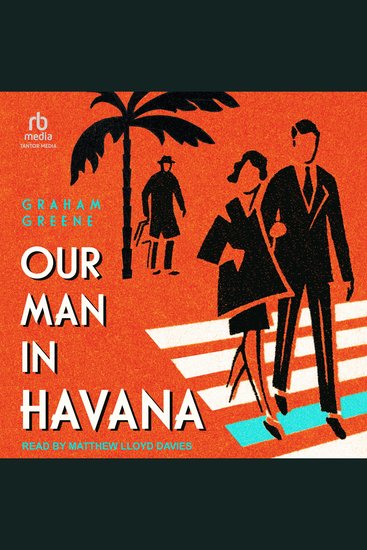
  • Our Man in Havana - cover

    Our Man in Havana

    Graham Greene

    • 0
    • 0
    • 0
    MI6's man in Havana is Wormold, a former vacuum-cleaner salesman turned reluctant secret agent out of economic necessity. To keep his job, he files bogus reports based on Charles Lamb's Tales from Shakespeare and dreams up military installations from vacuum-cleaner designs. Then his stories start coming disturbingly true . . . 


    First published in 1959 against the backdrop of the Cold War, Our Man in Havana remains one of Graham Greene's most widely enjoyed novels. It is an espionage thriller, a penetrating character study, and a political satire of government intelligence that still resonates today.
    Mostra libro
  • Jules Vern Around The World In 80 Days - Stories For Everyone - cover

    Jules Vern Around The World In...

    Jules Verne

    • 0
    • 0
    • 0
    Mysterious Phileas Fogg is a man of the most repetitious and punctual habit - with no apparent sense of adventure whatsoever - he gambles his considerable fortune that he can complete a journey around the world in just 80 days... immediately after a newspaper calculates the feat as just barely possible. With his excitable French manservant in tow, Fogg undertakes the exercise immediately, with no preparations, trusting that his traveling funds will make up for delays along the way. But unbeknownst to him, British police are desperately seeking to arrest him for the theft of a huge sum by someone who resembles him, and they will track him around the world, if necessary, to apprehend him. This is an adventure novel of the first water, with wholly unexpected perils, hair-breadth escapes, brilliant solutions to insoluble problems, and even a love story. And can this be? - That he returns to London just five minutes too late to win his wager and retain his fortune?  
     
    Jules Gabriel Verne was a French novelist, poet, and playwright. His collaboration with the publisher Pierre-Jules Hetzel led to the creation of the Voyages extraordinaires, a series of bestselling adventure novels.
    Mostra libro