

Begleiten Sie uns auf eine literarische Weltreise!
Buch zum Bücherregal hinzufügen
Grey
Einen neuen Kommentar schreiben Default profile 50px
Grey
Jetzt das ganze Buch im Abo oder die ersten Seiten gratis lesen!
All characters reduced
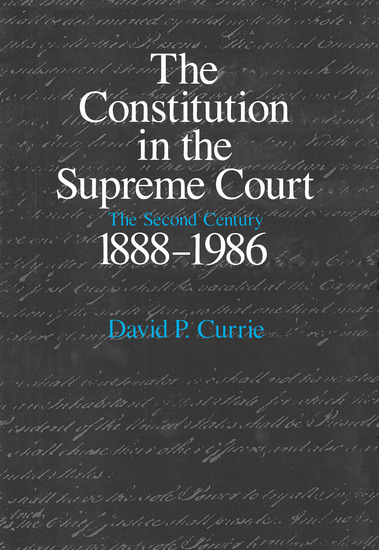
The Constitution in the Supreme Court - The Second Century 1888–1986 - cover

The Constitution in the Supreme Court - The Second Century 1888–1986

David P. Currie

Verlag: The University of Chicago Press

  • 0
  • 0
  • 0

Beschreibung

The Constitution in the Supreme Court: The Second Century traces the development of the Supreme Court from Chief Justice Fuller (1888-1910) to the retirement of Chief Justice Burger (1969-1986). Currie argues that the Court's work in its second century revolved around two issues: the constitutionality of the regulatory and spending programs adopted to ameliorate the hardships caused by the Industrial Revolution and the need to protect civil rights and liberties. Organizing the cases around the tenure of specific chief justices, Currie distinguishes among the different methods of constitutional exegesis, analyzes the various techniques of opinion writing, and evaluates the legal performance of different Courts. "Elegant and readable. Whether you are in favor of judicial restraint or judicial activism, whatever your feelings about the Warren Court, or the Renquist Court, this is a book that justifies serious study."—Robert Stevens, New York Times Book Review
Verfügbar seit: 27.02.2015.
Drucklänge: 684 Seiten.

Weitere Bücher, die Sie mögen werden

  • Meet The Three Princesses - cover

    Meet The Three Princesses

    Judith Annique Francois

    • 0
    • 0
    • 0
    “Meet the Three Princesses” is a heart-warming story about a loving family who live in Haiti. Readers will enjoy the bright, beautiful illustrations and interesting story details that highlight the unique, lovely charm of a small island town.Esther, Cassandra and Rosa are happy girls, but they miss their father when he is away at work. They don’t know he has a wonderful surprise in store! Will this surprise show his sweet daughters how much he thinks of them all throughout the day?  Read along and share the special love, joy and pride that Mama and Papa have for their three princesses. A beautiful, uplifting family tale.
    Zum Buch
  • Great American Socialist The: Eugene Debs 1890-1919 - cover

    Great American Socialist The:...

    Eugene Debs

    • 0
    • 0
    • 0
    Six months ago, I had never heard the name Eugene Debs. Today, I believe he is one of the greatest orators in history, ranking alongside Napoleon, Robespierre, Lincoln, and Cicero. More importantly, he was a genuine hero, a man to believe in and follow into the fires of hell. His legacy has been unrightly ignored by the same powers that imprisoned and harassed him over his life. He should be an icon, but is unremembered, for reasons he himself goes into. However, there is one key difference between Debs and these other orators: every one of the others fought for empire, or glory, or democracy – but Debs fought for the working man’s right to a decent existence.A railroad man from 15, he founded then turned against the unions as they became tools of the owners, and won 3% of the presidential vote in 1920 despite being a) the Socialist candidate and b) in prison for sedition. The two major speeches missing from this volume can be found in the prior collection, being “You Railroad Men”, whose content is covered in other speeches herein, and “Statement to the Court”, which is summarised in part 4 of Scott Nearing’s analysis.
    Zum Buch
  • School as a community - Researching leadership in Waldorf schools - cover

    School as a community -...

    Hans Passenier

    • 0
    • 0
    • 0
    In search of leadership in Waldorf schools.
    Leadership in Waldorf schools has a specific history. Whereas 40 years ago it was hardly allowed to formally exist because it represented power and hierarchy, now it is commonplace to have a headmaster, rector or director. In this book, Hans Passenier examines the development of leadership and organisation in Waldorf schools. He starts at the origins and finds principles that can help develop school organisations and their leadership in the future. In four parts, he unfolds the foundations, the tools to develop leadership and organisations and finally describes exercises to support that development as a school community.
    His thesis is that education is about children being diverse, having different abilities. Also that the educator should not be a carpenter, but a gardener. The image of the school as an organism is guiding, in which the school community is a place for the inner development of each individual in that school community.
    The horizontal and vertical dimensions guide the view of both leadership and organisational design.
    Zum Buch
  • Enchantment: Part VII - Duel (Yaoi Gay Fantasy Erotica) - cover

    Enchantment: Part VII - Duel...

    Kai Aubrey

    • 0
    • 0
    • 0
    In the catacombs deep beneath the palace, a portal floats suspended above an occult altar. 
    Heath steps forward, gazing at his reflection in the glassy, pale blue surface. This is the gateway to the realm of the incubi...and Soren awaits within. 
    Passing through the enchanted gate, Heath readies himself for whatever darkness lies beyond. The time has arrived for his audience with the Emperor of Lust. 
    ***CONTAINS EXPLICIT GAY SEXUAL CONTENT*** 
    Written by Kai Aubrey. Narrated by Arcadian Audios. 
    For more content, visit www.KaiAubrey.com.
    Zum Buch
  • Summary of Bret Baier and Catherine Whitney’s Three Days in Moscow - cover

    Summary of Bret Baier and...

    Falcon Press

    • 0
    • 0
    • 0
    Buy now to get the main key ideas from Bret Baier and Catherine Whitney’s Three Days in Moscow 
      
    In Three Days in Moscow (2018), Bret Baier of Fox News and his co-writer Catherine Whitney tell a story of patriotism, courage, and ambition, about a man who went to the full extent for the sake of his nation, without ever compromising democracy. 
    This political biography focuses on President Ronald Reagan’s agenda during his final years in office, before the fall of the Soviet Union. It chronicles major stages that marked his two-term presidency, especially his visit to the USSR for the Moscow summit with Soviet President Mikhail Gorbachev. Both leaders showed how long-term enemies could break through historical grievances for the common interest of their nations, as a new, post-Soviet era finally started to unfold. Reagan felt he only had three days to make his appeal and convince the Russian people of the importance of democracy; he had been awaiting this moment for the majority of his life.
    Zum Buch
  • The Middle Kingdom of Egypt - A Period of Restoration and Growth - cover

    The Middle Kingdom of Egypt - A...

    Omar Khalil

    • 0
    • 0
    • 0
    The Middle Kingdom of Egypt marked a transformative period following the turmoil of the First Intermediate Period. This era, spanning roughly from 2050 to 1710 BCE, saw the reunification of Egypt under the leadership of Mentuhotep II, the pharaoh who established stability after years of political fragmentation. As the nation emerged from chaos, the Middle Kingdom laid the foundations for a revitalized state, fostering political, cultural, and economic growth. 
    The collapse of the Old Kingdom had left Egypt divided, with rival factions vying for control. This power vacuum led to the rise of regional rulers known as nomarchs, whose increasing autonomy weakened central authority. The struggle for dominance between these local leaders marked the First Intermediate Period, characterized by instability and fragmented governance. However, the emergence of Mentuhotep II, a ruler from Thebes, marked a turning point. Determined to restore order, he led a series of military campaigns to reunite Upper and Lower Egypt. His victory over the Herakleopolitan kings signified the dawn of a new era. 
    Reunification under Mentuhotep II not only consolidated political power but also reestablished the role of the pharaoh as a central figure of authority. As the unifier of Egypt, Mentuhotep II portrayed himself as the restorer of ma'at—harmony and justice. His reign marked the beginning of the 11th Dynasty and set a precedent for strong, centralized rule. The restoration of internal stability allowed for significant cultural and artistic developments, reflecting a renewed sense of national identity.
    Zum Buch
