Join us on a literary world trip!
Add this book to bookshelf
Grey
Write a new comment Default profile 50px
Grey
Subscribe to read the full book or read the first pages for free!
All characters reduced
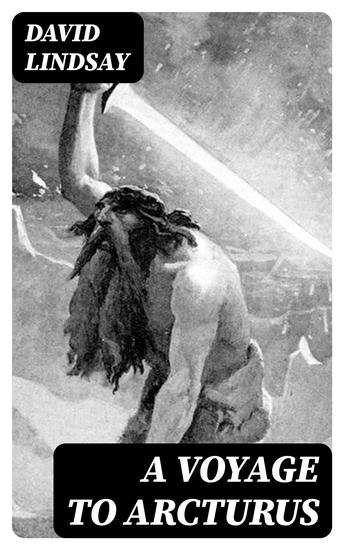
A Voyage to Arcturus - cover

A Voyage to Arcturus

David Lindsay

Publisher: DigiCat

  • 0
  • 0
  • 0

Summary

In "A Voyage to Arcturus," David Lindsay crafts a remarkable blend of philosophical inquiry and science fiction, propelling readers into an enigmatic and allegorical journey through alien landscapes. The protagonist, Maskull, traverses the far reaches of the universe, encountering a series of unique beings and experiences that reflect the inner struggles of the human condition. Lindsay's distinctive literary style melds rich imagery with dense, imaginative prose, drawing comparisons to the works of H.G. Wells and D.H. Lawrence while anchoring itself in early 20th-century existential thought. The novel investigates themes of identity, reality, and the nature of existence, prompting readers to contemplate the limits of human understanding against the boundless possibilities of the cosmos. David Lindsay, a Scottish author and mystic, was influenced by early evolutionary thought, philosophical contemplation, and personal quests for truth, which deeply informed his fiction. His background in philosophy and his exploration of metaphysical questions shaped his literary vision, driving him to create a work that embodies both escapist adventure and profound introspection. Despite being published in 1920, the themes present in Lindsay's narrative resonate strongly with contemporary inquiries into the self and the universe. For those seeking a thought-provoking exploration of existence intertwined with imaginative storytelling, "A Voyage to Arcturus" stands as a seminal work in the canon of speculative fiction. It challenges readers to journey beyond the surface of reality and examine their own beliefs, making it a significant read for enthusiasts of philosophical literature and science fiction alike.
Available since: 10/11/2022.
Print length: 242 pages.


Other books that might interest you

  • Little Women (Part 1) - cover

    Little Women (Part 1)

    Louisa May Alcott

    • 0
    • 0
    • 0
    Little Women (Part 1): Four sisters and their mother, whom they call Marmee, live in a new neighborhood (loosely based on Concord) in Massachusetts in genteel poverty. Having lost all his money, their father is serving as a chaplain for the Union Army in the American Civil War, far from home. The mother and daughters face their first Christmas without him. When Marmee asks her daughters to give their Christmas breakfast away to an impoverished family, the girls and their mother venture into town laden with baskets to feed the hungry children. When they return, they discover their wealthy, elderly neighbor Mr. Laurence has sent over a decadent surprise dinner to make up for their breakfast. The two families become acquainted following these acts of kindness.
    Little Women is a coming-of-age novel written by American novelist Louisa May Alcott, originally published in two volumes in 1868 and 1869. The story follows the lives of the four March sisters—Meg, Jo, Beth, and Amy—and details their passage from childhood to womanhood. Loosely based on the lives of the author and her three sisters, it is classified as an autobiographical or semi-autobiographical novel.
    Show book
  • Silas Marner - cover

    Silas Marner

    George Eliot

    • 0
    • 0
    • 0
    Though brief in length, George Eliot’s (Mary Ann Evans) Silas Marner is a beautifully nuanced tale. It touches on many themes such as social acceptance, the harshness of legalistic religion, the equally harsh consequences of familial expectations and the power of a simple but fierce redemptive love. 
    The touching story is gently unfolded by Eliot in writing which beautifully captures the tragic disfunctions of the Cass family and the humorous characters of Raveloe who slowly grow to accept the strange Weaver in their midst. At its heart is Silas Marner himself, enigmatic and remote to those who don’t know him, but we who are allowed to glimpse his bruised heart, know that restoration may still be his. 
    Head Stories Audio presents Silas Marner by George Eliot. Narrated by Simon Hester. With original music.
    Show book
  • The Shepherdess and the Chimney-sweeper - cover

    The Shepherdess and the...

    H. C. Andersen

    • 0
    • 0
    • 0
    Classic short story by Andersen about a porcelain romance.
    Show book
  • Annabel Lee - cover

    Annabel Lee

    Edgar Allan Poe

    • 0
    • 0
    • 0
    Annabel Lee is the last complete poem by Edgar Allan Poe. Like many of Poe's poems, it explores the theme of the death of a beautiful woman. 
    The narrator, who fell in love with Annabel Lee when they were young, has a love for her so strong that even angels are jealous. He retains his love for her even after her death. 
    There has been debate over who - if anyone - was the inspiration for Annabel Lee. Though many women have been suggested, Poe's wife Virginia Eliza Clemm Poe is one of the more credible candidates. 
    ©2009 Listen & Live Audio, Inc.; (P)2009 Listen & Live Audio, Inc.
    Show book
  • Eumenides - cover

    Eumenides

    Aeschylus

    • 0
    • 0
    • 0
    The final play of the Oresteia, called The Eumenides (Εὐμενίδες, Eumenídes), illustrates how the sequence of events in the trilogy ends up in the development of social order or a proper judicial system in Athenian society. 
    In this play, Orestes is hunted down and tormented by the Furies, a trio of goddesses known to be the instruments of justice, who are also referred to as the "Gracious Ones" (Eumenides). They relentlessly pursue Orestes for the killing of his mother. However, through the intervention of Apollo, Orestes is able to escape them for a brief moment while they are asleep and head to Athens under the protection of Hermes. Seeing the Furies asleep, Clytemnestra's ghost comes to wake them up to obtain justice on her son Orestes for killing her.
    Show book
  • Gods in Exile - Heine pulls at many threads in this essay short story using the reincarnation of the famous Greek gods into medieval Christian Europe as his subject matter to do this - cover

    Gods in Exile - Heine pulls at...

    Heinrich Heine

    • 0
    • 0
    • 0
    Christian Johann Heinrich Heine was born in Düsseldorf, Germany on 13th December 1797 to assimilated Jewish parents. 
     
    Heine studied law at the universities of Bonn, Göttingen, and Berlin but his greater commitment was to studying poetry and literature.   
     
    He converted to Protestantism in order to obtain work as there were draconian anti-Jewish laws in force at the time.   
     
    He was part of the German Romantic movement but also responsible in part for ushering in the post-Romantic crisis and the presumed failure of art as unable to overcome or explain the growing traumas of modernity.  However, his literary reputation was cemented in the second half of the 1820’s with his poetry collection ‘The Book of Songs’ together with his collection of ‘Pictures of Travel’ stories that blended fact and fiction together into commercial and critical successes. 
     
    After the July 1830 Revolution in France, he went to live in Paris, where he remained until his death.  
     
    Here he wrote much in the way of essays discussing the political and cultural scene in France together with volumes of social criticism on Germany. 
     
    By 1835, his works had been banned by the German government.  His lifelong subsidised lifestyle ended in 1844 when his uncle died leaving him nothing.  He turned once more to lyric poetry and created perhaps his finest poetical works.  A trip to Germany resulted in the long satirical poem ‘Germany. A Winter's Tale’. His second volume of poetry, ‘New Poems’ in 1844, included poems that had originally appeared in Karl Marx’s newspaper ‘Forward’ and continued the satirical style he now preferred.   
     
    In May 1848, Heine, in poor health, fell and was paralyzed and confined to his bed.  He called it his ‘mattress-grave’ and only death would remove him from it.  He was also experiencing eye problems and suffering from chronic lead poisoning. 
     
    Heinrich Heine died on 17th February 1856.  He was 58.   
     
    ‘Gods in Exile’ is perhaps a prophetic piece on his own life.  The old gods are overthrown by the new novelty of Christianity.  What will be their role now?  Is there life after for them?
    Show book