Join us on a literary world trip!
Add this book to bookshelf
Grey
Write a new comment Default profile 50px
Grey
Subscribe to read the full book or read the first pages for free!
All characters reduced
The Divine Comedy - cover

The Divine Comedy

Alighieri Dante

Translator Henry Wadsworth Longfellow

Publisher: Classic Harbor

  • 0
  • 0
  • 0

Summary

Enter a journey beyond the boundaries of the known world—through darkness, redemption, and eternal light.

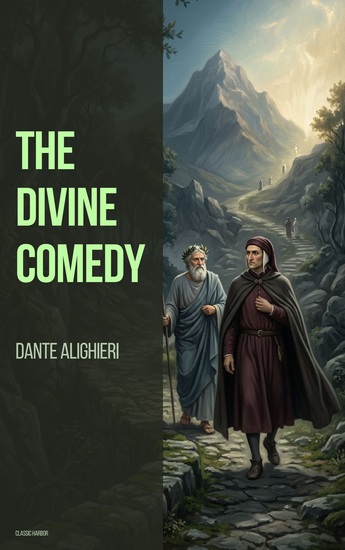
Dante Alighieri's The Divine Comedy is one of the most influential works of world literature, following a remarkable spiritual journey through three realms of the afterlife: Inferno, Purgatorio, and Paradiso.

Guided through a universe of punishment, purification, and divine revelation, Dante encounters unforgettable figures from history, mythology, politics, and his own life. Along the way, the poem explores profound questions of sin and virtue, justice and mercy, love and faith, human weakness and spiritual transformation.

Blending epic storytelling with philosophy, theology, mythology, and vivid imagery, The Divine Comedy remains a monumental work of medieval literature and a timeless exploration of the human search for meaning.

Perfect for readers interested in:

Epic poetry and classic literature
Dante Alighieri and medieval literature
Hell, Purgatory, and Paradise
Mythology, theology, and philosophy
Spiritual journeys and redemption
Influential works of world literature
Literary classics with allegorical depth

Begin Dante's extraordinary journey from the depths of despair to the heights of paradise—and experience one of literature's greatest visions of the human soul.
Available since: 09/18/2026.
Print length: 500 pages.
Other books that might interest you

  • Resilient Grieving Second Edition - How to Find Your Way Through a Devastating Loss - cover

    Resilient Grieving Second...

    PhD Lucy Hone, PhD Karen Reivich

    • 0
    • 0
    • 0
    The death of someone we hold dear may be inevitable; being paralyzed by our grief is not. Recent research has revealed our capacity for resilient grieving, our innate ability to respond to traumatic loss by finding ways to grow—by becoming more engaged with our lives, and discovering new, profound meaning. 


    In this completely updated and expanded second edition, author and resilience/well-being expert Lucy Hone, a pioneer in positive psychology and bereavement research, continues to push her field forward. In 2014, Lucy was faced with her own inescapable sorrow after her twelve-year-old daughter was killed in a car accident. By following the strategies of resilient grieving, she found a proactive way to move through her grief, and, over time, embrace life again. Since then, Lucy has become a leading voice in resilience and bereavement science, overturning widely held myths and misconceptions, making plain the harms of rigid models such as Kübler-Ross's five stages, and advocating for a more adaptive grieving process that emphasizes emotions, relationships, attention, forgiveness, and self-compassion. 


    As heard on NPR's Hidden Brain and CBS News 


    2017 Foreword INDIES Bronze Winner
    Show book
  • Fat Off Fat On - A Big Bitch Manifesto - cover

    Fat Off Fat On - A Big Bitch...

    Clarkisha Kent

    • 0
    • 0
    • 0
    In this disarming and candid memoir, cultural critic Clarkisha Kent unpacks the kind of compounded problems you face when you’re a fat, Black, queer woman in a society obsessed with heteronormativity. 
     
    There was no easy way for Kent to navigate personal discovery and self-love. As a dark-skinned, first-generation American facing a myriad of mental health issues and intergenerational trauma, at times Kent’s body felt like a cosmic punishment. In the face of body dysmorphia, homophobia, anti-Blackness, and respectability politics, the pursuit of “high self-esteem” seemed oxymoronic. 
     
    Fat Off, Fat On: A Big Bitch Manifesto is a humorous, at times tragic, memoir that follows Kent on her journey to realizing that her body is a gift to be grown into, that sometimes family doesn’t always mean home, and how even ill-fated bisexual romances could free her from gender essentialism. Perfect for readers of Keah Brown’s The Pretty One, Alida Nugent’s You Don’t Have to Like Me, and Stephanie Yeboah’s Fattily Ever After, Kent’s debut explores her own lived experiences to illuminate how fatphobia intertwines with other oppressions. It stresses the importance of addressing the violence scored upon our minds and our bodies, and how we might begin the difficult—but joyful—work of setting ourselves free.
    Show book
  • Modern Latin America: A Captivating Guide to Modern Latin American History - cover

    Modern Latin America: A...

    Captivating History

    • 0
    • 0
    • 0
    Uncover the Real Story of Latin America—A History That Is Still Unfolding 
    Latin America is so much more than the Amazon and Christopher Columbus. It’s a place full of stories about independence, tough fighters, and rich cultures. But how did this region become what it is today? And what has shaped its journey? 
    This audiobook tells the story of modern Latin America in a simple, clear way. You’ll learn how years of struggle and strength helped shape the diverse societies we know today. 
    Here is a taste of what you will learn about in this audiobook:Ancient Civilizations: Discover the amazing inventions of the first people in Latin America.Fight for Independence: Read about the brave battles that freed Latin America from European control.Revolutions and Changes: See how different fights and ideas have shaped the countries of Latin America.Famous Figures: Meet important people like Simón Bolívar and “Che” Guevara, who helped change history.World Wars Impact: Learn how global conflicts affected Latin America in surprising ways.And much more. 
    Why This Audioook Is Different: 
    This audiobook is an easy guide that helps you understand the history of Latin America without tripping over big words. It’s perfect for adults who want to know more about this vibrant region in an engaging way. 
    Ready to dive into the real story behind modern Latin America? Scroll up and click the “add to cart” button to start your journey!
    Show book
  • Voices of Famous Spiritual Leaders Volume 2 - cover

    Voices of Famous Spiritual...

    William Bell Riley, Homer...

    • 0
    • 0
    • 0
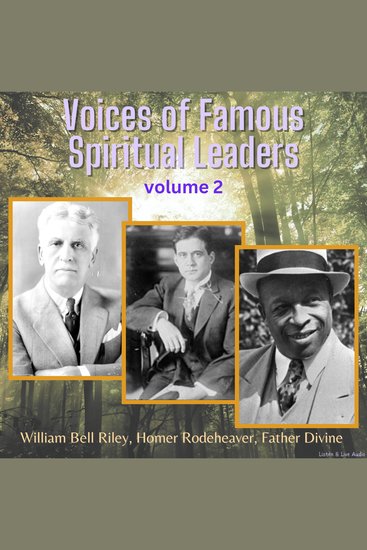
    William Bell Riley (March 22, 1861 - December 5, 1947) was known as "The Grand Old Man of Fundamentalism". Born and educated in Indiana, Riley received his teacher's certificate and, later, graduated from the Southern Baptist Theological Seminary in Louisville, KY. He served several Baptist churches in Kentucky, Indiana, and Illinois before taking the pastorate at the First Baptist Church in Minneapolis, MN, in 1897. 
    Father Divine (1876 - 1965), also known as Reverend Major Jealous Divine, was an African American spiritual leader from 1907 until his death. He founded the International Peace Mission movement, formulated its doctrine of economic independence and racial equality, and oversaw its growth from a small and predominantly black congregation into a multiracial and international church. 
    Homer Alvan Rodeheaver (October 4, 1880 - December 18, 1955) was an American evangelist, music director, music publisher, composer of gospel songs, and pioneer in the recording of sacred music. From 1910 to 1930, he served as musical director for Billy Sunday, the most popular evangelist of the period, using his baritone voice to effect as a soloist and as a participant in ensembles composed of other members of Sunday's evangelistic team. 
    ©2016 Listen & Live Audio, Inc. (P)2016 Listen & Live Audio, Inc.
    Show book
  • Paris Is Not Dead - Surviving Hypergentrification in the City of Light - cover

    Paris Is Not Dead - Surviving...

    Cole Stangler

    • 0
    • 0
    • 0
    The Paris of popular imagination is lined with cobblestone streets and stylish cafés, a beacon for fashionistas and well-heeled tourists. But French-American journalist Cole Stangler, celebrated for his reporting on Paris and French politics, argues that the beating heart of the City of Light lies elsewhere—in its striving, working-class districts whose residents are being priced out of their hometown today. 


    Paris Is Not Dead explores the past, present, and future of the City of Light through the lens of class conflict, highlighting the outsized role of immigrants in shaping the city's progressive, cosmopolitan, and open-minded character—at a time when politics nationwide can feel like they're shifting in the opposite direction. This is the Paris many tourists too often miss: immigrant-heavy districts such as the 18th arrondissement, where crowded street markets still define everyday life. Stangler brings this view of the city to life, combining gripping, street-level reportage, stories of today's working-class Parisians, recent history, and a sweeping analysis of the larger forces shaping the city. 


    In the tradition of Lucy Sante and Mike Davis, Paris Is Not Dead offers a bottom-up portrait of one of the world's most vital urban centers—and a call to action to Francophiles and all who care about the future of cities everywhere.
    Show book
  • The Chicago Canon on Free Inquiry and Expression - cover

    The Chicago Canon on Free...

    Tony Banout, Tom Ginsburg

    • 0
    • 0
    • 0
    A collection of texts that provide the foundation for the University of Chicago’s longstanding tradition of free expression, principles that are at the center of current debates within higher education and society more broadly. Free inquiry and expression are hotly contested, both on campus and in social and political life. Since its founding in the late nineteenth century, the University of Chicago has been at the forefront of conversations around free speech and academic freedom in higher education. The University’s approach to free expression grew from a sterling reputation as a research university as well as a commitment to American pragmatism and democratic progress, all of which depended on what its first president referred to as the “complete freedom of speech on all subjects.” In 2015, more than 100 years later, then University provost and president J. D. Isaacs and Robert Zimmer echoed this commitment, releasing a statement by a faculty committee led by law professor Geoffrey R. Stone that has come to be known as the Chicago Principles, now adopted or endorsed by one hundred US colleges and universities. These principles are just a part of the long-standing dialogue at the University of Chicago around freedom of expression—its meaning and limits. The Chicago Canon on Free Inquiry and Expression brings together exemplary documents – some published for the first time here – that explain and situate this ongoing conversation with an introductory essay that brings the tradition to light.
    
    At a time of nationwide campus speech debates, engaging with these texts and the questions they raise is essential to sustaining an environment of broad intellectual and ideological diversity. This book offers a blueprint for the future of higher education’s vital work and points to the civic value of free expression. 
    Show book