Join us on a literary world trip!
Add this book to bookshelf
Grey
Write a new comment Default profile 50px
Grey
Subscribe to read the full book or read the first pages for free!
All characters reduced
Whispers Beyond the Veil - A Mesmerizing Journey Through Dark Realms That Will Leave You Questioning Reality - cover

Whispers Beyond the Veil - A Mesmerizing Journey Through Dark Realms That Will Leave You Questioning Reality

Cassandra Vale

Publisher: JHco-operation limited

  • 0
  • 0
  • 0

Summary

Some doors should never be opened. Some whispers should never be heard…When archivist Evelyn Marlowe uncovers a forgotten manuscript hidden deep within the Calderstone Library, she unknowingly unseals a passageway between worlds. The book—ancient, cryptic, and written in no known language—draws her into a chilling reality where shadows move on their own, voices speak without a source, and the dead don't always stay silent.Each story in this atmospheric collection unveils a piece of a greater, haunting truth: there is a veil that separates our world from the unknown… and it's beginning to tear.Blending supernatural suspense with literary elegance, Whispers Beyond the Veil is a spine-tingling journey through forbidden knowledge, ghostly visitations, and the lingering echoes of those who never found peace. With evocative prose by Cassandra Vale and the resonant narration of Silas Greystone, this immersive experience is for fans of gothic horror, cosmic mysteries, and the unsettling beauty of the unseen.Once you hear the whispers… you can never unhear them.
Available since: 06/17/2025.
Print length: 63 pages.

Other books that might interest you

  • The Heart Is Deceitful Above All Things - Stories - cover

    The Heart Is Deceitful Above All...

    JT LeRoy

    • 0
    • 1
    • 0
    The national bestselling novel-in-stories of a gender nonconforming teen’s coming of age is as “vivid as a match held close to the face” (New York Times). 
     
    The internationally acclaimed short story collection from JT LeRoy, available once more with a new foreword by Jeff Feuerzeig, writer and director of the documentary, Author: The JT LeRoy Story 
     
    This book of interconnected stories depicts the chaotic life of a young boy on the run with his teenage mother. When Sarah reclaims Jeremiah from his foster parents, he finds himself catapulted into her world of motels and truck stops, exposed to the abusive, exploitative men she encounters. As he learns to survive in this harrowing environment, Jeremiah also learns to love his mother, even as she descends into drug-fueled madness. 
     
    Told in spare, lyrical prose, rich with imagination and dark humor, The Heart Is Deceitful Above All Things transforms the savagery of Jeremiah's world into an indelible experience of compassion. This special edition includes an additional seven stories, previously uncollected, by JT LeRoy, the literary persona of Laura Albert. 
     
    “A startling achievement.” —Publishers Weekly 
     
    “Beautifully structured and written.” —Hubert Selby Jr., author of Last Exit to Brooklyn 
     
    “Remarkable.” —Booklist 
     
    “Strong, fierce, hard . . . Astonishing.”— Kirkus Reviews 
     
    “LeRoy writes like Flannery O'Connor tied to the bed and plied with angel dust.” ?Jerry Stahl, author of Perv: A Love Story and Permanent Midnight 
     
    “[LeRoy is] a hungry writer with the instincts of a person who fishes to eat. Once he hooks the reader he doesn't let go.” ?Bookforum 
     
    “The Heart Is Deceitful Above All Things [has] grit, tragedy, and power. The force of the story continues to exist.” —Lit Hub
    Show book
  • South of the Slot - Iconic American author London brings a story ahead of its time in this influential story about class and labour - cover

    South of the Slot - Iconic...

    Jack London

    • 0
    • 0
    • 0
    John Griffith Chaney was born on January 12th, 1876 in San Francisco.   
     
    His father, William Chaney, was living with Flora Wellman when she became pregnant.  Chaney insisted she have an abortion.  Flora's response was to turn a gun on herself.  Although her wounds were not severe the trauma made her temporarily deranged. 
     
    In late 1876 his mother married John London and the young child was brought to live with them as they moved around the Bay area, eventually settling in Oakland where now, calling himself Jack, he completed grade school. 
     
    Jack worked hard at several jobs, sometimes 12-18 hours a day, but his dream was university.  He studied hard and borrowed the money to enrol in the summer of 1896 at the University of California in Berkeley. 
     
    In 1897, at 21, Jack searched out newspaper accounts of his mother's suicide attempt and for the name of his biological father. He wrote to Chaney, then living in Chicago, who claimed he could not be Jack’s father because he was impotent and casually asserted that London's mother had relations with other men.  Jack, devastated by the response, quit Berkeley and went to the Klondike. Other accounts suggest that his dire finances presented Jack with the excuse he needed to leave. 
     
    In the Klondike Jack began to gather material for his writing but also accumulated many health problems, including scurvy, which together with hip and leg problems he would carry for the rest of his life. 
     
    During the late 1890's Jack was regularly publishing short stories and by the turn of the century full blown novels. 
     
    By 1904 Jack had married, fathered two children and was now in the process of divorcing.  A stint as a reporter on the Russo-Japanese war of 1904 was equal amounts trouble and experience. But that experience was always put to good use in a continuing and remarkable output of work. 
     
    In 1905 he married Charmian Kittredge who at last was a soul and companion who brought him some semblance of peace despite his advancing alcoholism and his incurable wanderlust. 
     
    Twelve years later Jack had amassed both wealth and a literary reputation through such classics as ‘The Call of the Wild’, ‘White Fang’ and many others. He had a reputation as a social activist and was a tireless friend of the workers.   
     
    Jack London died suffering from dysentery, late-stage alcoholism and uremia, aged only 40, on November 22nd 1916 at his property in Glen Elen in California 
     
    In ‘South of the Slot’ Jack London reveals yet another facet of his writing talents. In turn of the Century San Francisco, a Professor of Sociology explores the working-class neighbourhoods gradually revealing an alter-ego with his Union loving personality and name.  The question is which is his real character.
    Show book
  • Devil's Manhunt - cover

    Devil's Manhunt

    L. Ron Hubbard

    • 0
    • 0
    • 0
    Tim Beckdolt, rangy and self-reliant, is as American as the frontier itself. He has spent eight hard months digging $175,000 in gold out of Arizona's Desperation Peak — but two strangers have taken his gold, and now they want to take his life. In a place where the only law is the law of survival, Beckdolt will have to live by his wits... or die by the bullet. The fists are flying and the guns are blazing as the audio version of Devil's Manhunt puts you hot on the trail of blistering Wild West action.
    Show book
  • Sheridan Le Fanu - A Short Story Collection - An anthology from the Irish master of gothic and horror fiction who's work would greatly influence prominent names such as MR James and Bram Stoker - cover

    Sheridan Le Fanu - A Short Story...

    Sheridan Le Fanu

    • 0
    • 0
    • 0
    Joseph Thomas Sheridan Le Fanu was born on August 28th, 1814, at 45 Lower Dominick Street, Dublin, into a literary family with Huguenot, Irish and English roots 
     
    The children were tutored but, according to his brother William, the tutor taught them little if anything. Le Fanu was eager to learn and used his father's library to educate himself about the world. He was a creative child and by fifteen had taken to writing poetry. 
     
    Accepted into Trinity College, Dublin to study law he also benefited from the system used in Ireland that he did not have to live in Dublin to attend lectures, but could study at home and take examinations at the university as and when necessary. 
     
    This enabled him to also write and by 1838 Le Fanu's first story The Ghost and the Bonesetter was published in the Dublin University Magazine. Many of the short stories he wrote at the time were to form the basis for his future novels.  Indeed, throughout his career Le Fanu would constantly revise, cannabilise, embellish and re-publish his earlier works to use in his later efforts. 
     
    Between 1838 and 1840 Le Fanu had written and published twelve stories which purported to be the literary remains of an 18th-century Catholic priest called Father Purcell. Set mostly in Ireland they include classic stories of gothic horror, with grim, shadowed castles, as well as supernatural visitations from beyond the grave, together with madness and suicide. One of the themes running through them is a sad nostalgia for the dispossessed Catholic aristocracy of Ireland, whose ruined castles stand in mute salute and testament to this history.  
     
    On 18 December 1844 Le Fanu married Susanna Bennett, the daughter of a leading Dublin barrister. The union would produce four children.  Le Fanu was now stretching his talents across the length of a novel and his first was The Cock and Anchor published in 1845. 
     
    A succession of works followed and his reputation grew as well as his income.  Unfortunately, a decade after his marriage it became an increasing source of difficultly. Susanna was prone to suffer from a range of neurotic symptoms including great anxiety after the deaths of several close relatives, including her father two years before.  
     
    In April 1858 she suffered an "hysterical attack" and died in circumstances that are still unclear. The anguish, profound guilt as well as overwhelming loss were channeled into Le Fanu’s work.  Working only by the light of two candles he would write through the night and burnish his reputation as a major figure of 19th Century supernaturalism. His work challenged the focus on the external source of horror and instead he wrote about it from the perspective of the inward psychological potential to strike fear in the hearts of men.  
     
    A series of books now came forth: Wylder's Hand (1864), Guy Deverell (1865), The Tenants of Malory (1867), The Green Tea (1869), The Haunted Baronet (1870), Mr. Justice Harbottle (1872), The Room in the Dragon Volant (1872) and In a Glass Darkly. (1872). 
     
    But his life was drawing to a close.  Joseph Thomas Sheridan Le Fanu died in Merrion Square in his native Dublin on February 7th, 1873, at the age of 58.  
     
    01 - Joseph Sheridan Le Fanu - A Short Story Collection - An Introduction 
    02 - The Ghost and the Bone-Setter by Sheridan Le Fanu 
    03 - Sir Dominick's Bargain by Sheridan Le Fanu 
    04 - Dickon the Devil by Sheridan Le Fanu 
    05 - Strange Event in the Life of Schalken the Painter by Sheridan Le Fanu 
    06 - An Account of Some Strange Disturbances in Aungier Street by Sheridan Le Fanu
    Show book

  • Too Early - cover

    Too Early

    Anton Chekhov

    • 0
    • 0
    • 0
    The story takes place in the village of Shalmovo, where two peasant sportsmen, Filimon Slyunka and Ignat Ryabov, are sitting in a pothouse turned restaurant. Slyunka is an old man who used to be a house-serf and now lives off his old wife's alms. Ryabov is a silent, sturdy peasant. Slyunka and Ryabov are trying to convince the innkeeper, Semyon Mitritch, to give them a gun that they had left as collateral. Semyon refuses, citing the Lenten season and the lack of game. Despite their pleas and promises to return the gun, Semyon remains firm in his decision. Slyunka and Ryabov leave the tavern and decide to go stand-shooting in the forest, hoping to find snipe. They walk to the forest, but find no snipe and decide to wait another five days before trying again. The story ends with the sportsmen walking home in silence. Overall, the story portrays a slice of rural life and explores themes of poverty, longing, and the connection between humans and nature.
    Show book
  • Aristocratic Education - From their pens to your ears genius in every story - cover

    Aristocratic Education - From...

    Stephen Leacock

    • 0
    • 0
    • 0
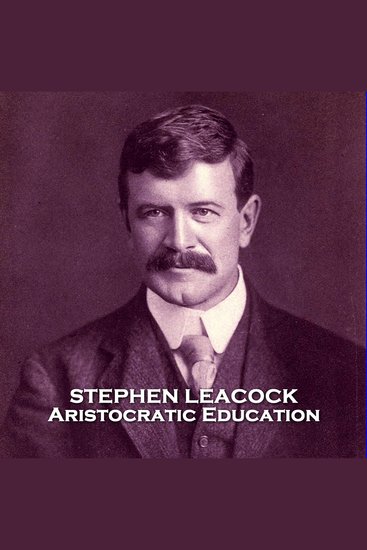
    Stephen P H Butler Leacock FRSC was born on the 30th December 1869 in Swanmore, near Southampton, England, the third of eleven children. 
    The family emigrated to Canada in 1876 to live on a 100-acre farm in Sutton, Ontario.  There Leacock was home-schooled and later enrolled into the elite private school Upper Canada College in Toronto.  Academically he was very strong and enrolled at the University of Toronto to study languages and literature.  He left there after his alcoholic father abandoned the family and finances were too stretched to continue his attendance.  He now enrolled in a three-month course at Strathroy Collegiate Institute to become a qualified high school teacher and with it a regular income. 
    Leacock published humorous articles in many Canadian and US magazines but his real passion was economics and political theory.  In 1899 he enrolled for postgraduate studies at the University of Chicago and earned his PhD in 1903. 
    His marriage to Beatrix Hamilton produced a single child 15 years later.  Over time father and son developed a love-hate relationship, partially caused by his son’s diminutive stature of only four feet.  
    He accepted a post at McGill University and kept it until he retired in 1936.  His work ‘Elements of Political Science’, was adopted as a standard textbook for two decades and was also his most profitable.  He now also began public speaking and lecturing.  
    In 1910, he privately printed some articles as ‘Literary Lapses’.  It was then released by a recognised publisher, and he became a commercially successful writer.  His collections of light-hearted whimsy, parody, nonsense, and satire were now frequently published along with biographies and several award-winning volumes on Canada. 
    Politically Leacock was a difficult creature.  He opposed women’s right to vote, was a champion of Empire but advocated social welfare legislation and wealth redistribution, but he often caused friction with his racist views. 
    Leacock has been forgotten as an economist, but it’s often said that in 1911 more people had heard of him than had heard of Canada.  For the decade after 1915 Leacock was the most popular humorist in the English-speaking world. 
    Stephen Leacock died on 28th March 1944 of throat cancer in Toronto, Canada.  He was 74.
    Show book