Rejoignez-nous pour un voyage dans le monde des livres!
Ajouter ce livre à l'électronique
Grey
Ecrivez un nouveau commentaire Default profile 50px
Grey
Abonnez-vous pour lire le livre complet ou lisez les premières pages gratuitement!
All characters reduced
The Lair of the White Worm - cover

The Lair of the White Worm

Bram Stoker

Maison d'édition: Caelwick Press

  • 0
  • 0
  • 0

Synopsis

The Lair of the White Worm by Bram Stoker is offered here in a clean English digital edition prepared for fluent ebook reading. The work stands within horror and gives modern readers direct access to a public-domain classic with navigable structure and a restrained typographic presentation. The opening pages establish the book's atmosphere with this first movement: Adam Salton sauntered into the Empire Club, Sydney, and found awaiting him a letter from his grand-uncle. He had first heard from the old gentleman less than a year before, when Richard Salton had claimed kinship, stating that he had been unable to write earlier, as he had found it very difficult to This edition is suited to readers who want a reliable, uncluttered version of the text for study, rediscovery, and sustained reading.
Disponible depuis: 06/06/2026.
Longueur d'impression: 190 pages.
D'autres livres qui pourraient vous intéresser

  • The Pupil - A Tale of a Shabby-Genteel Family - cover

    The Pupil - A Tale of a...

    Henry James

    • 0
    • 0
    • 0
    A poor young tutor is hired by a shabby-genteel family drifting round the hotels of Europe, and finds his pupil is the cleverest person in the household and the only one ashamed of it. James wrote it in 1891 and thought it among his best; the boy's education consists of learning exactly what his parents are, and the tutor's consists of learning what he himself will not do. Fifty-eight plates of dinners, tea tables, sewing hands and portraits by painters including Henry Sargent and Giovanni Boldini catch the shabby-genteel interiors and watchful faces of the world the tutor enters.
    Voir livre
  • Tom Swift and His Wireless Message - cover

    Tom Swift and His Wireless Message

    Victor Appleton

    • 0
    • 0
    • 0
    Tom Swift and His Wireless Message by Victor Appleton is an exciting classic adventure that follows the brilliant young inventor as he explores the groundbreaking world of wireless communication. Blending scientific innovation with fast-paced action, this captivating installment of the beloved Tom Swift series showcases the power of ingenuity, determination, and imagination in the face of unexpected challenges.
    
    When an important wireless message becomes central to a thrilling adventure, Tom must rely on his technical expertise, quick thinking, and unwavering courage to solve complex problems and overcome dangerous obstacles. As events unfold, he encounters mystery, suspense, and exciting discoveries that highlight the importance of perseverance, responsibility, and creative problem-solving.
    
    Victor Appleton's engaging storytelling combines memorable characters, imaginative inventions, and compelling adventure with the optimism of the early twentieth century's technological revolution. Rich in suspense, wholesome values, and scientific curiosity, the novel celebrates innovation while capturing the excitement of an era shaped by remarkable advances in communication.
    
    Perfect for readers who enjoy classic adventure fiction, invention stories, science-themed novels, and tales of technological discovery, Tom Swift and His Wireless Message remains a timeless favorite that inspires curiosity, celebrates engineering achievement, and demonstrates the enduring value of intelligence, courage, and perseverance.
    Voir livre
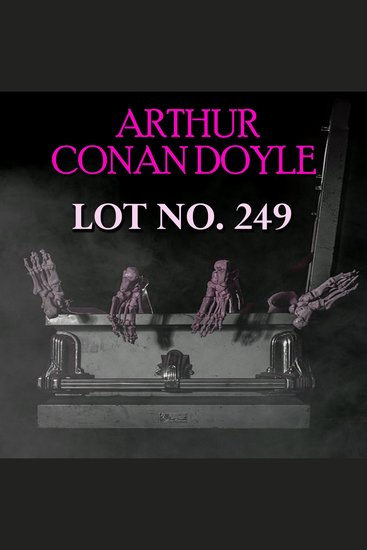
  • Lot No 249 - cover

    Lot No 249

    Arthur Conan Doyle

    • 0
    • 0
    • 0
    Lot No. 249 is a Gothic horror short story by British writer Arthur Conan Doyle, first published in Harper's Magazine in 1892. The story tells of a University of Oxford athlete named Abercrombie Smith who notices a strange series of events surrounding Edward Bellingham, an Egyptology student who owns many ancient Egyptian artefacts, including a mummy. After seeing his mummy disappear and reappear, and two instances of Bellingham's enemies getting attacked, Smith concludes that Bellingham is reanimating his mummy. Smith confronts Bellingham, who denies this is the case; the next day, Smith is attacked by the mummy and escapes. Smith then forces Bellingham to destroy his mummy and the associated artefacts at gunpoint.Written during a period of great European interest in Egyptian culture known as Egyptomania, "Lot No. 249" was inspired by Doyle's interests in the supernatural, crime and Egyptology. Though reanimated mummies had previously appeared in English literature, Doyle's story was the first to portray one as dangerous. The story has been widely anthologised and received positive reviews from critics, including praise from authors H. P. Lovecraft and Anne Rice. Critics have compared the story to the writings of Edgar Allan Poe and H. Rider Haggard and interpreted it as containing themes of imperialism and masculinity. "Lot No. 249" has been adapted for film and television, and has significantly influenced subsequent media that depicts mummies, as well as other works of horror fiction.
    Voir livre
  • Paddy At Home: Story Of A Minister - cover

    Paddy At Home: Story Of A Minister

    THE BARON E. DE MANDAT-GRANCEY

    • 0
    • 0
    • 0
    Paddy At Home: Story of a Minister by The Baron E. de Mandat-Grancey is a humorous and satirical story that focuses on the life of a minister named Paddy. The book explores the challenges and absurdities of his daily life, offering a witty critique of religious and societal norms. Through humorous anecdotes and engaging storytelling, Mandat-Grancey paints a picture of a clergyman caught between his religious duties and the realities of the world around him.
    Voir livre
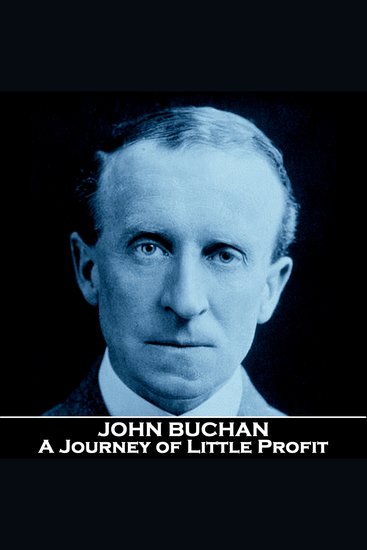
  • A Journey of Little Profit - From their pens to your ears genius in every story - cover

    A Journey of Little Profit -...

    John Buchan

    • 0
    • 0
    • 0
    The Scottish novelist John Buchan enjoyed a remarkable career as politician, historian and Governor General. He was born John Buchan on 26th August 1875 and later added 1st Baron Tweedsmuir PC GCMG GCVO CH to his name.  
    Buchan studied at Hutchesons’ Grammar School, Glasgow and at seventeen won a scholarship to the University of Glasgow to study classics. There he began to write poetry. In 1895 he transferred to Oxford to continue his study of Classics and in 1896 ‘Sir Quixote of the Moors’ was published followed by the non-fiction ‘Scholar-Gipsies’. His prolific literary output now hardly faltered. 
    He graduated in 1900 and became the private secretary to Alfred Milner, the High Commissioner for Southern Africa and other colonies. Buchan found the same inspiration in the African landscape as he had in the Scottish Borders, and would later set many works here. Returning to London he became a partner in a publishing house, and garnered an editorial role at The Spectator. He also completed his law studies. He was called to the bar in 1901 but never practiced.  
    On 15th July 1907 Buchan married Susan Charlotte Grosvenor, the cousin of the Duke of Westminster. In 1910 he wrote ‘Prester John’, the first of a series set in South Africa.  
    In 1911 Buchan entered politics as a Unionist candidate in the Scottish Borders advocating the support of free trade, women’s suffrage, national insurance, and reducing the power of the House of Lords.  
    The Great War saw Buchan writing for the War Propaganda Bureau and as Times correspondent in France. In 1915, he published ‘The Thirty-Nine Steps’, his most famous book and a follow-up Richard Hannay novel, ‘Greenmantle’, in 1916.  
    In 1916 Buchan enlisted in the Intelligence Corps which included writing speeches for Sir Douglas Haig. By 1917 he was Director of Information under Lord Beaverbrook. Buchan called it “the toughest job he ever took on”. He somehow found time to assist in a history of the war magazine. This was later published in 24 volumes: Nelson’s History of the War. 
    After the war his writing focused on historical studies. In 1927 Buchan became the Unionist Party Member of Parliament for the Combined Scottish Universities. In a speech to Parliament he said “I believe every Scotsman should be a Scottish nationalist. If it could be proved that a Scottish parliament were desirable… Scotsmen should support it.”  
    Over the next decade he continued to distinguish himself politically and in literature.  On the 1st June 1935 he became 1st Baron Tweedsmuir of Elsfield in the County of Oxford.  
    He was now also given the position of Governor General in Canada and resolved to travel all over Canada to gain a better insight of the country. Having crossed both length and breadth he saw the cultural shift between areas and their common ground and helped bring about a clear national Canadian identity. 
    On the 6th February 1940 he collapsed from a stroke and sustained a very serious head injury in falling. Two rounds of surgery to stabilise his condition were unsuccessful and Buchan died on the 11th February. After a state funeral in Ottawa his ashes were returned to his estate in Oxfordshire.
    Voir livre
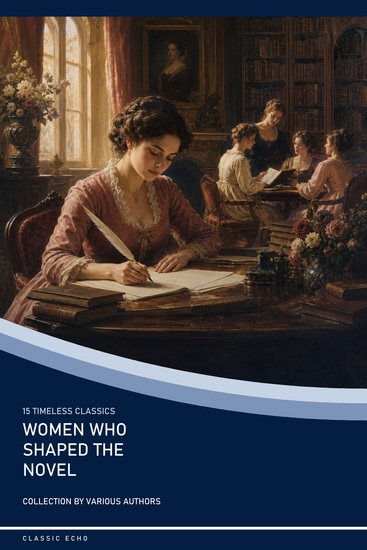
  • Women Who Shaped the Novel - 15 Timeless Classics by Jane Austen the Brontës Elizabeth Gaskell and Louisa May Alcott - cover

    Women Who Shaped the Novel - 15...

    Louisa May Alcott, Jane Austen,...

    • 0
    • 0
    • 0
    Experience fifteen complete classics by Jane Austen, Charlotte, Emily and Anne Brontë, Elizabeth Gaskell and Louisa May Alcott. From Pride and Prejudice and Jane Eyre to Wuthering Heights, North and South and Little Women, this collection celebrates unforgettable heroines and extraordinary literary voices.
    
    The novels flow from wit and social observation to passion, independence and family life. Clear book dividers and a detailed table of contents make this substantial library inviting and simple to explore.
    Voir livre