

Begleiten Sie uns auf eine literarische Weltreise!
Buch zum Bücherregal hinzufügen
Grey
Einen neuen Kommentar schreiben Default profile 50px
Grey
Jetzt das ganze Buch im Abo oder die ersten Seiten gratis lesen!
All characters reduced
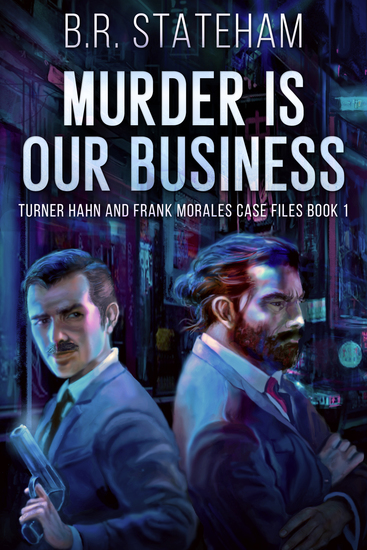
Murder is Our Business - cover

Murder is Our Business

B.R. Stateham

Verlag: Next Chapter

  • 0
  • 0
  • 0

Beschreibung

Ten stories from the Case Files of homicide detectives Turner Hahn and Frank Morales, these are tales of murder, deception, greed and mayhem only this duo can solve.
 
Murder is the operative word in this collection: from hardened criminals to deceitful damsels, to the cold minds of serial killers. Come along for the ride as Turner and Frank face off with the crazies, the cunning and the brilliant, as they try to get away with murder.
 
For Turner and Frank, the city pays them to do a job. But that's okay... they're good at what they do.
Verfügbar seit: 15.12.2021.

Weitere Bücher, die Sie mögen werden

  • Sentiment Inc - cover

    Sentiment Inc

    Poul Anderson

    • 0
    • 0
    • 0
    In Sentiment, Inc., Poul Anderson masterfully blends science fiction and psychological intrigue. The story follows a young physicist who stumbles upon a mysterious company claiming to control human emotions. As he investigates, he uncovers a web of manipulation, ethical dilemmas, and unforeseen consequences. What starts as a scientific curiosity soon becomes a fight for free will. Anderson's sharp storytelling and thought-provoking themes explore the boundaries of science and morality. This gripping tale challenges the reader to consider: if emotions could be controlled, who would truly be in charge? A must-listen for fans of classic sci-fi and speculative fiction.
    Zum Buch
  • A Journey of Little Profit - From their pens to your ears genius in every story - cover

    A Journey of Little Profit -...

    John Buchan

    • 0
    • 0
    • 0
    The Scottish novelist John Buchan enjoyed a remarkable career as politician, historian and Governor General. He was born John Buchan on 26th August 1875 and later added 1st Baron Tweedsmuir PC GCMG GCVO CH to his name.  
    Buchan studied at Hutchesons’ Grammar School, Glasgow and at seventeen won a scholarship to the University of Glasgow to study classics. There he began to write poetry. In 1895 he transferred to Oxford to continue his study of Classics and in 1896 ‘Sir Quixote of the Moors’ was published followed by the non-fiction ‘Scholar-Gipsies’. His prolific literary output now hardly faltered. 
    He graduated in 1900 and became the private secretary to Alfred Milner, the High Commissioner for Southern Africa and other colonies. Buchan found the same inspiration in the African landscape as he had in the Scottish Borders, and would later set many works here. Returning to London he became a partner in a publishing house, and garnered an editorial role at The Spectator. He also completed his law studies. He was called to the bar in 1901 but never practiced.  
    On 15th July 1907 Buchan married Susan Charlotte Grosvenor, the cousin of the Duke of Westminster. In 1910 he wrote ‘Prester John’, the first of a series set in South Africa.  
    In 1911 Buchan entered politics as a Unionist candidate in the Scottish Borders advocating the support of free trade, women’s suffrage, national insurance, and reducing the power of the House of Lords.  
    The Great War saw Buchan writing for the War Propaganda Bureau and as Times correspondent in France. In 1915, he published ‘The Thirty-Nine Steps’, his most famous book and a follow-up Richard Hannay novel, ‘Greenmantle’, in 1916.  
    In 1916 Buchan enlisted in the Intelligence Corps which included writing speeches for Sir Douglas Haig. By 1917 he was Director of Information under Lord Beaverbrook. Buchan called it “the toughest job he ever took on”. He somehow found time to assist in a history of the war magazine. This was later published in 24 volumes: Nelson’s History of the War. 
    After the war his writing focused on historical studies. In 1927 Buchan became the Unionist Party Member of Parliament for the Combined Scottish Universities. In a speech to Parliament he said “I believe every Scotsman should be a Scottish nationalist. If it could be proved that a Scottish parliament were desirable… Scotsmen should support it.”  
    Over the next decade he continued to distinguish himself politically and in literature.  On the 1st June 1935 he became 1st Baron Tweedsmuir of Elsfield in the County of Oxford.  
    He was now also given the position of Governor General in Canada and resolved to travel all over Canada to gain a better insight of the country. Having crossed both length and breadth he saw the cultural shift between areas and their common ground and helped bring about a clear national Canadian identity. 
    On the 6th February 1940 he collapsed from a stroke and sustained a very serious head injury in falling. Two rounds of surgery to stabilise his condition were unsuccessful and Buchan died on the 11th February. After a state funeral in Ottawa his ashes were returned to his estate in Oxfordshire.
    Zum Buch
  • Top 10 Short Stories The - The 19th Century - The English - The top ten short stories written from 1800 - 1899 by English authors - cover

    Top 10 Short Stories The - The...

    George Eliot

    • 0
    • 0
    • 0
    Short stories have always been a sort of instant access into an author’s brain, their soul and heart.  A few pages can lift our lives into locations, people and experiences with a sweep of landscape, narration, feelings and emotions that is difficult to achieve elsewhere. 
     
    In this series we try to offer up tried and trusted ‘Top Tens’ across many different themes and authors. But any anthology will immediately throw up the questions – Why that story? Why that author?  
     
    The theme itself will form the boundaries for our stories which range from well-known classics, newly told, to stories that modern times have overlooked but perfectly exemplify the theme.  Throughout the volume our authors whether of instant recognition or new to you are all leviathans of literature. 
     
    Some you may disagree with but they will get you thinking; about our choices and about those you would have made.  If this volume takes you on a path to discover more of these miniature masterpieces then we have all gained something. 
     
    In this Century England assembles more of the world’s territories, people and materials for her own Empire.  The arts also flourish with names in this volume that are bywords for talent beyond the reach of almost all other writers.  An ever hungry audience demands yet more and more. 
     
    1 - The Top 10 - The 19th Century - The English - An Introduction 
    2 - The Lifted Veil - Part 1 by George Eliot 
    3 - The Lifted Veil - Part 2 by George Eliot 
    4 - The Signalman by Charles Dickens 
    5 - The Man Who Would Be King - Part 1 by Rudyard Kipling 
    6 - The Man Who Would Be King - Part 2 by Rudyard Kipling 
    7 - The Magic Shop by H G Wells 
    8 - The Withered Arm by Thomas Hardy 
    9 - The Old Nurse's Story by Elizabeth Gaskell 
    10 - A Little Dinner At Timmin's by William Makepeace Thackeray 
    11 - Father Giles of Ballymoy by Anthony Trollope 
    12 - Lost Hearts by M R James 
    13 - A Terribly Strange Bed by Wilkie Collins
    Zum Buch
  • Metzengerstein - cover

    Metzengerstein

    Edgar Allan Poe

    • 0
    • 0
    • 0
    Step into the dark and foreboding world of Edgar Allan Poe’s Metzengerstein, a gothic tale filled with vengeance, mystery, and the supernatural. In this chilling story, an age-old feud between two powerful families takes a terrifying turn as a young Baron becomes obsessed with a spectral horse and a series of ominous events begins to unfold. As fire, revenge, and fate collide, the line between reality and the supernatural blurs in a tale that only Poe could craft. 
    Narrated by Christopher Mireider, this audiobook captures the haunting and suspenseful essence of Poe’s writing. Mireider’s voice brings the tension and dread of the story to life, immersing listeners in the eerie and atmospheric world of Metzengerstein. His performance adds depth to Poe’s masterful storytelling, making for an unforgettable listening experience. 
    Perfect for fans of gothic literature and classic horror, Metzengerstein delves into the themes of doom, obsession, and the unrelenting power of fate. Prepare to be captivated by this dark tale that showcases Poe’s unparalleled ability to evoke fear and wonder in equal measure.
    Zum Buch
  • The Silver Scream - cover

    The Silver Scream

    Roy Merkin

    • 0
    • 0
    • 0
    Fresh from the cutting room floor, The Silver Scream exposes the bloodiest behind-the-scenes details of the most gruesome, shocking, true-crime tragedy of our time. Part autopsy, part grisly director’s “cut,” this is the only book with a comprehensive exploration inside the mind of America’s notorious, celluloid-obsessed, rock star turned cinema-copycat murderer, Spencer Charnas. Bayonet Award–winning television reporter Roy Merkin is the only storyteller in possession of the journals scrawled by disgraced psychotherapist Dr. Ian Black. The Silver Scream reconstructs, with unflinching detail, how fiction became fact, art imitated death, and the most horrific movie murders by the likes of Jason, Leatherface, Freddy, Michael, and the rest became real. Merkin courageously slashes open the ghoulish mind and tortured nightmares of Spencer himself, probing deeply, with razor-sharp precision. Learn how the box office created so many oblong boxes.  
     
    Understand why this rock n’ roll heartthrob chose to stop so many human hearts.
    Zum Buch
  • Edward Page Mitchell - A Short Story Collection - A pioneer of the Sci Fi genre the first man to write about invisibility time travel and teleportation - cover

    Edward Page Mitchell - A Short...

    Edward Page Mitchell

    • 0
    • 0
    • 0
    Edward Page Mitchell – An Introduction 
     
    Edward Page Mitchell was born in Bath, Maine on 24th March 1852 into a wealthy family.  When he was eight the family moved to a house on New York’s Fifth Avenue. 
     
    In 1863 he witnessed the Draft Riots and in the aftermath Mitchell's father moved the family to Tar River, North Carolina. It was there, at the age of fourteen, that his letters were first published in the local newspaper The Bath Times. 
     
    In 1872, at age twenty, whilst on a train journey to Bath, Maine, a hot cinder from the engine's smokestack flew in through the window blinding his left eye.  After several weeks, while doctors attempted to restore his sight his uninjured right eye underwent sympathetic blindness.  He was now completely blind. His burnt left eye eventually regained its sight, but his uninjured right eye remained blind and was later removed surgically and replaced with a prosthetic glass eye. While recovering from this surgery, Mitchell wrote his famed story ‘The Tachypomp’. 
     
    He became a journalist for the Daily Advertiser in Boston, where his mentor was Edward Everett Hale, now also recognized as an early pioneer of science fiction. 
     
    Mitchell’s influence on science fiction writing is incredible, pre-dating many major themes. He wrote about a man made invisible (‘The Crystal Man’, 1881), a time-travel machine (‘The Clock that Went Backward’), about faster-than-light travel (‘The Tachypomp’, 1874), a thinking computer and a cyborg (‘The Ablest Man in the World’, 1879), matter transmission or teleportation (‘The Man without a Body’, 1877), superior mutants (‘Old Squids and Little Speller’) and mind transfer (‘Exchanging Their Souls’, 1877). Add to this other stories which predicted travel by pneumatic tube, electrical heating, newspapers printed at home, food-pellet concentrates, international broadcasts, and suspended animation through cryogenics amount to talents that are not as publicly lauded as they should be. 
     
    He had a lifelong interest in the supernatural and paranormal—several early newspaper pieces are factual investigations of alleged hauntings and usually he determined they had rational explanations. 
     
    In 1874, Mitchell married Annie Sewall Welch and they had four children.  
     
    In 1903, Mitchell became editor-in-chief of the New York Sun, then the Nation’s leading newspaper. 
     
    In 1912, following Annie’s death, he married Ada M. Burroughs and produced a fifth son. Mitchell remained a popular and respected figure in American journalism and writing up to his death. 
     
    Edward Page Mitchell died of a cerebral hemorrhage in New London, Connecticut on 22nd January 1927.  He was 76. 
     
    1 - Edward Page Mitchell - A Short Story Collection - An Introduction 
    2 - The Clock That Went Backward by Edward Page Mitchell 
    3 - The Tachypomp by Edward Page Mitchell 
    4 - The Man Without a Body by Edward Page Mitchell 
    5 - The Devilish Rat by Edward Page Mitchell 
    6 - The Crystal Man by Edward Page Mitchell
    Zum Buch
