Join us on a literary world trip!
Add this book to bookshelf
Grey
Write a new comment Default profile 50px
Grey
Subscribe to read the full book or read the first pages for free!
All characters reduced
Lonesome Roads and Streets of Dreams - Place Mobility and Race in Jazz of the 1930s and '40s - cover

Lonesome Roads and Streets of Dreams - Place Mobility and Race in Jazz of the 1930s and '40s

Andrew S. Berish

Publisher: The University of Chicago Press

  • 0
  • 0
  • 0

Summary

Any listener knows the power of music to define a place, but few can describe the how or why of this phenomenon. In Lonesome Roads and Streets of Dreams: Place, Mobility, and Race in Jazz of the 1930s and ’40s, Andrew Berish attempts to right this wrong, showcasing how American jazz defined a culture particularly preoccupied with place. By analyzing both the performances and cultural context of leading jazz figures, including the many famous venues where they played, Berish bridges two dominant scholarly approaches to the genre, offering not only a new reading of swing era jazz but an entirely new framework for musical analysis in general, one that examines how the geographical realities of daily life can be transformed into musical sound.  Focusing on white bandleader Jan Garber, black bandleader Duke Ellington, white saxophonist Charlie Barnet, and black guitarist Charlie Christian, as well as traveling from Catalina Island to Manhattan to Oklahoma City, Lonesome Roads and Streets of Dreams depicts not only a geography of race but how this geography was disrupted, how these musicians crossed physical and racial boundaries—from black to white, South to North, and rural to urban—and how they found expression for these movements in the insistent music they were creating.  
Available since: 02/06/2012.
Print length: 326 pages.

Other books that might interest you

  • 101 Amazing Facts about BTS - cover

    101 Amazing Facts about BTS

    Merlin Mill

    • 0
    • 0
    • 0
    Do you know how much BTS contribute to the South Korean economy each year? What Spotify record does the band hold? What video game has Jin played since he was five years old? And which alternative stage names did Jungkook consider before settling on the one we all know and love? 
    In this fantastic audiobook, Lizzie Abbott talks us through more than hundred facts about BTS, the band that has conquered the world. Whether you are a long-standing member of the ARMY, or you are only just now getting into the work of Jin, Suga, J-Hope, RM, Jimin, V and Jungkook, this is the perfect addition to your collection!
    Show book
  • A Very Nervous Person's Guide to Horror Movies - cover

    A Very Nervous Person's Guide to...

    Mathias Clasen

    • 0
    • 0
    • 0
    Why your worst nightmares about watching horror movies are unfounded 
     
    Films about chainsaw killers, demonic possession, and ghostly intruders make some of us scream with joy. But while horror fans are attracted to movies designed to scare us, others shudder already at the thought of the sweatdrenched nightmares that terrifying movies often trigger. The fear of sleepless  
    nights and the widespread beliefs that horror movies can have negative psychological effects and display immorality make some of us very, very nervous about them. But should we be concerned? 
     
    In this book, horror-expert Mathias Clasen delves into the psychological science of horror cinema to bust some of the worst myths and correct the biggest misunderstandings surrounding the genre. In short and highly readable chapters peppered with vivid anecdotes and examples, he addresses the nervous person’s  
    most pressing questions: What are the effects of horror films on our mental and physical health? Why do they often cause nightmares? Aren’t horror movies immoral and a bad influence on children and adolescents? Shouldn’t we be concerned about what the current popularity of horror movies says about society  
    and its values? While media psychologists have demonstrated that horror films indeed have the potential to harm us, Clasen reveals that the scientific evidence also contains a second story that is often overlooked: horror movies can also help us confront and manage fear and bring us closer together.
    Show book
  • The Place Where You Go to Listen - In Search of an Ecology of Music - cover

    The Place Where You Go to Listen...

    John Luther Adams

    • 0
    • 0
    • 0
    Did Alaska create the music of John Luther Adams, or did the music create his Alaska? For the past thirty years, the vastness of Alaska has swept through the distant reaches of the composer's imagination and every corner of his compositions. In this new book Adams proposes an ideal of musical ecology, the philosophical foundation on which his largest, most complex musical work is based. This installation, also called The Place Where You Go to Listen, is a sound and light environment that gives voice to the cycles of sunlight and darkness, the phases of the moon, the seismic rhythms of the earth, and the dance of the aurora borealis. Adams describes this work as "a place for hearing the unheard music of the world around us." The book includes two seminal essays, the composer's journal telling the story of the day-to-day emergence of The Place, as well as musical notations, graphs and illustrations of geophysical phenomena.
    Show book
  • The Tradition - A New History of Welsh Art 1400–1990 - cover

    The Tradition - A New History of...

    Peter Lord

    • 0
    • 0
    • 0
    Peter Lord, considered to be the greatest living scholar on Welsh visual art and culture, surveys the evolution of the visual culture of Wales from the Renaissance to the end of the twentieth century in this new, single-volume history. Written for everyone with an interest in the art and history of Wales, the volume illustrates some 400 landscapes and portrait paintings, prints and sculptures from artists such as Augustus John, Ceri Richards, Christopher Williams and many more. The author describes both how the work emerged from its Welsh historical context and was related to the art of other cultures. Revealing the many discoveries made since its first publication of the Visual Culture of Wales series in 1998, The Tradition is the only study now in print that encompasses the whole field of Welsh visual art. It is published with the support of the National Museum of Wales, The Paul Mellon Foundation, the National Library of Wales, the Marc Fitch Fund, Swansea University and the Welsh Book Council.
    Includes new and expanded material not originally featured within Lord's Visual Culture of Wales series.
    Show book
  • Songbook - The Lyrics and Music of Steven Heighton - cover

    Songbook - The Lyrics and Music...

    Steven Heighton

    • 0
    • 0
    • 0
    From the award-winning, multi-genre author and musician Steven Heighton, Songbook brings together Heighton’s lyrics and music for the first time in a single volume, including his final songs, which have never been heard or seen until now. When Steven Heighton died suddenly of cancer in 2022, he was in the middle of an intensely creative period of songwriting. He released his first album of original material, The Devil’s Share, in 2021 and was preparing to record his second album. Known first as a poet, Heighton had always held that “music and poetry are two words for the same thing.”
    		 
    As in his songwriting, in Songbook, Heighton moves fluidly between genres and subjects, from political songs like “The Butcher’s Bill,” about the carelessness of nations sending their youth to war, to reimagining the myth of Orpheus (“I'll hold my breath the whole way down / And find your soul in the undertown”), to blues tunes like “Last Living Woman Alive,” and a tribute to the late John Prine, the “Buddha of Song.” With chords accompanying the lyrics, readers and musicians have the ability to bring the songs to life with their own interpretations. The music in Songbook was the final work of Heighton’s life, and it is not only a gift to have his lyrics and chords but an invitation from Heighton himself, challenging his readers to answer the call and keep singing along.
    Show book
  • Kakatiya Dynasty - Fortresses Flourishing Trade and Administrative Genius - cover

    Kakatiya Dynasty - Fortresses...

    Rolf Hedger

    • 0
    • 0
    • 0
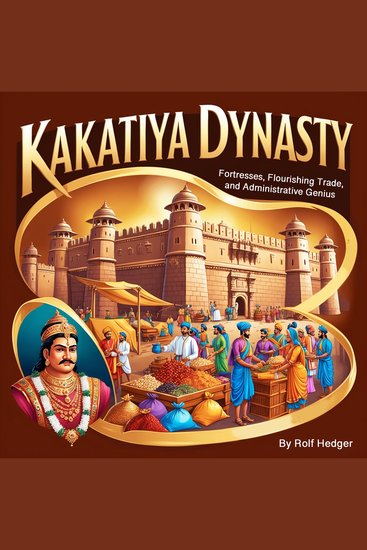
    The Kakatiya Dynasty emerged as a formidable power in the Deccan region of India, leaving behind a rich legacy of military strength, administrative brilliance, and cultural contributions. Their origins can be traced back to the 10th century, though historical records regarding their early rulers remain scarce. Initially, the Kakatiyas served as feudatories under the Rashtrakutas and later the Western Chalukyas, gradually expanding their influence over the Telugu-speaking region. 
    The name "Kakatiya" is believed to have originated from their association with the goddess Kakati, a form of Durga, who was worshipped as their family deity. The earliest known ruler, Venna or Beta I, established the dynasty’s foundation, but it was during the reign of Prola I that the Kakatiyas started asserting their independence. Prola II played a crucial role in strengthening their foothold by resisting Chalukyan dominance and expanding Kakatiya control over the eastern Deccan. 
    During this period, the Deccan was a contested space where multiple regional powers sought dominance. The Kakatiyas capitalized on the declining influence of the Western Chalukyas, strategically aligning themselves with or resisting various rulers to carve out an independent identity. Their stronghold was initially located in Hanamkonda, which later evolved into the grand city of Warangal, a center of Kakatiya power and cultural patronage.
    Show book