Junte-se a nós em uma viagem ao mundo dos livros!
Adicionar este livro à prateleira
Grey
Deixe um novo comentário Default profile 50px
Grey
Assine para ler o livro completo ou leia as primeiras páginas de graça!
All characters reduced
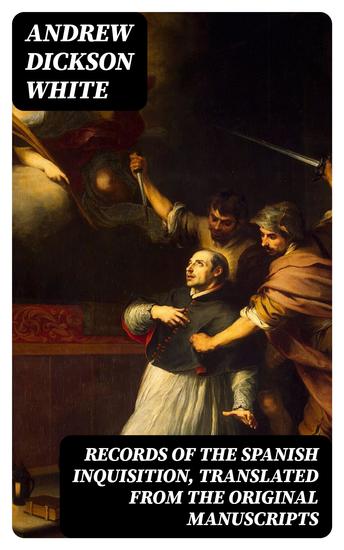
Records of the Spanish Inquisition Translated from the Original Manuscripts - cover
LER

Records of the Spanish Inquisition Translated from the Original Manuscripts

Andrew Dickson White

Editora: DigiCat

  • 0
  • 0
  • 0

Sinopse

In "Records of the Spanish Inquisition, Translated from the Original Manuscripts," Andrew Dickson White delves into one of history's most notorious institutions, presenting a meticulous collection of primary documents that illuminate the Inquisition's complex operations. White's literary style is characterized by a scholarly rigor, blending historical narrative with detailed analysis, making the sometimes daunting archival material accessible to a broader audience. The book is set against the backdrop of the 19th-century academic discourse on religious intolerance and the evolution of Enlightenment thought, providing context to the often polarized interpretations of the Inquisition. Andrew Dickson White was an influential historian, educator, and co-founder of Cornell University, whose deep commitment to academic freedom and critical inquiry drove him to explore the intersections of religion, science, and politics. His extensive background in both classical literature and history uniquely positioned him to undertake the translation and analysis of these manuscripts, as he sought to challenge prevailing myths and provide a clearer understanding of the Inquisition's impact on society. This seminal work is essential for anyone interested in the history of religious persecution, the evolution of human rights, or the interplay between faith and reason. White's translation serves as a crucial resource for scholars and lay readers alike, encouraging a nuanced understanding of a dark but pivotal era in the annals of European history.
Disponível desde: 02/06/2022.
Comprimento de impressão: 171 páginas.

Outros livros que poderiam interessá-lo

  • Forever Young - Unlocking The Secrets of Longevity - cover

    Forever Young - Unlocking The...

    Brian Gibson

    • 0
    • 0
    • 0
    "Forever Young: Unlocking the Secrets of Longevity" is a mesmerizing journey that beckons readers to embark on a transformative quest, guiding them through the enchanting realm of aging gracefully and thriving in the later stages of life. Like a radiant beacon of hope, this book illuminates the path to a vibrant, purposeful life filled with boundless possibilities. 
    With each page, the book reveals the delicate tapestry of wisdom, science, and profound insights woven together to unlock the secrets of longevity. Its pages hold the keys to a treasure trove of knowledge, inviting readers to unlock the secrets within their hearts and minds. Drawing from positive psychology, emotional intelligence, self-empowerment, and mindful living, "Forever Young" unveils a harmonious symphony of practices leading to a life transcending the mere passage of time. 
    With every chapter, "Forever Young" offers a delicate balance of inspiration and practical guidance, empowering readers to embrace the present moment with mindfulness and gratitude. It encourages readers to cast aside the limitations of age and societal expectations, embracing a life that is limitless in its possibilities.
    Ver livro
  • Submarines and the World Wars: The History of Submarine Warfare in World War I and World War II - cover

    Submarines and the World Wars:...

    Editors Charles River

    • 0
    • 0
    • 0
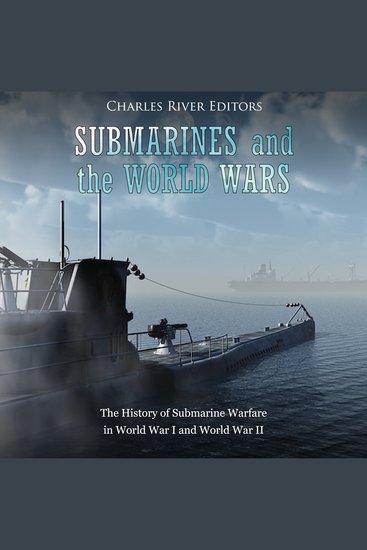
    During World War I, German U-boats operated solo except on one occasion. Initially, the British and nations supplying England with food and materiel scattered vessels singly across the ocean, making them vulnerable to the lone submarines. However, widespread late war re-adoption of the convoy system tipped the odds in the surface ships' favor, as one U-boat skipper described: “The oceans at once became bare and empty; for long periods at a time the U-boats, operating individually, would see nothing at all; and then suddenly up would loom a huge concourse of ships, thirty or fifty or more of them, surrounded by a strong escort of warships of all types.” 
    World War I proved the value of submarines, ensuring their widespread employment in the next conflict, and one critical innovation in World War II's Atlantic U-boat operations consisted of wolf-pack tactics, in which Admiral Karl Dönitz put great faith: “The greater the number of U-boats that could be brought simultaneously into the attack, the more favorable would become the opportunities offered to each individual attacker. 
    Meanwhile, submarines exercised a decisive impact on the outcome of the Pacific Theater in World War II. The U.S. submarine fleet, largely though not exclusively under the overall command of Vice Admiral Charles Lockwood, strangled the supply lines and shipping traffic of the Empire of Japan. Their commerce raiding crippled both Japan's ability to keep its frontline units supplied and to manufacture the weapons, vessels, and vehicles needed to successfully carry on the struggle. Though constituting only 1.6% of the total U.S. Navy’s tonnage in the Pacific, the submarine fleet inflicted massive losses on the Imperial Japanese Navy and Japan's crucial merchant marine. Submarines sank 55% of the merchant shipping lost, or approximately 1,300 vessels
    Ver livro
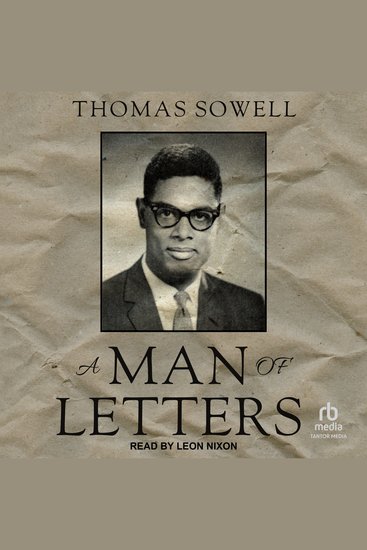
  • A Man of Letters - cover

    A Man of Letters

    Thomas Sowell

    • 0
    • 0
    • 0
    A Man of Letters traces the life, career, and commentaries on controversial issues of Thomas Sowell over a period of more than four decades through his letters to and from family, friends, and public figures ranging from Milton Friedman to Clarence Thomas, David Riesman, Arthur Ashe, William Proxmire, Vernon Jordan, Charles Murray, Shelby Steele, and Condoleezza Rice. These letters begin with Sowell as a graduate student at the University of Chicago in 1960 and conclude with a reflective letter to his fellow economist and longtime friend Walter Williams in 2005.
    Ver livro
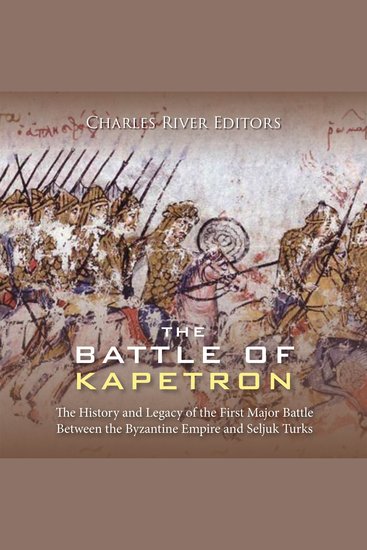
  • Battle of Kapetron The: The History and Legacy of the First Major Battle Between the Byzantine Empire and Seljuk Turks - cover

    Battle of Kapetron The: The...

    Editors Charles River

    • 0
    • 0
    • 0
    The Byzantine Empire existed for over a thousand years, with a history spanning from the division of the Roman Empire in 395 until the Ottoman conquest of Constantinople in 1453. It was formed from the previous Eastern Roman Empire, and during its long existence, the Byzantine inhabitants were very proud to call themselves Romans.  
    	However, many things changed during the long lifespan of the Byzantine Empire, starting with a Hellenization in the 6th century. The use of the Latin language diminished and Greek took its place, while the typical Roman culture gave way to a more Hellenistic one. The Hellenization of Byzantium was detrimental to the relationship with the Holy Roman Empire, and the Christian world from that point would be split in two. The subsequent strengthening of the Orthodox Church caused many civil wars and conflicts to arise during the centuries, which shattered and reshaped the territory time after time. By the end of the Byzantine Empire’s existence, the old age had weakened both the state and church, making it an easy target for invading forces.  
    	The most notable invaders were the Turkish-speaking Seljuks, led through a series of battles by Kutalmishouglu Suleiman, who supported different usurpers against the Byzantine emperor. The expansion of the Seljuks was so successful that when Suleiman died, he had put all of Bithynia under his control as well as several important harbor towns along the shores on the Asian side of Bosphorus. With that accomplishment, he had managed to separate the Byzantines living in Anatolia from their emperor in Constantinople. This immediately weakened the unity of the Byzantine Empire.  
    	Of all the conflicts that brought this state of affairs into being, few were as instrumental as the Battle of Kapetron, the culmination of one of the first major Seljuk raids into Byzantine territory.
    Ver livro
  • The Power to Destroy - How the Antitax Movement Hijacked America - cover

    The Power to Destroy - How the...

    Michael J. Graetz

    • 0
    • 0
    • 0
    The postwar United States enjoyed large, widely distributed economic rewards—and most Americans accepted that taxes were a reasonable price to pay for living in a society of shared prosperity. Then in 1978 California enacted Proposition 13, a property tax cap that Ronald Reagan hailed as a "second American Revolution," setting off an antitax, antigovernment wave that has transformed American politics and economic policy. In The Power to Destroy, Michael Graetz tells the story of the antitax movement and how it holds America hostage—undermining the nation's ability to meet basic needs and fix critical problems. 


    In 1819, Chief Justice John Marshall declared that the power to tax entails "the power to destroy." But The Power to Destroy argues that tax opponents now wield this destructive power. Attacking the IRS, protecting tax loopholes, and pushing tax cuts from Reagan to Donald Trump, the antitax movement is threatening the nation's social safety net, increasing inequality, ballooning the national debt, and sapping America's financial strength. The book chronicles how the movement originated as a fringe enterprise promoted by zealous outsiders using false economic claims and thinly veiled racist rhetoric, and how—abetted by conservative media and Grover Norquist's "taxpayer protection pledge"—it evolved into a mainstream political force.
    Ver livro
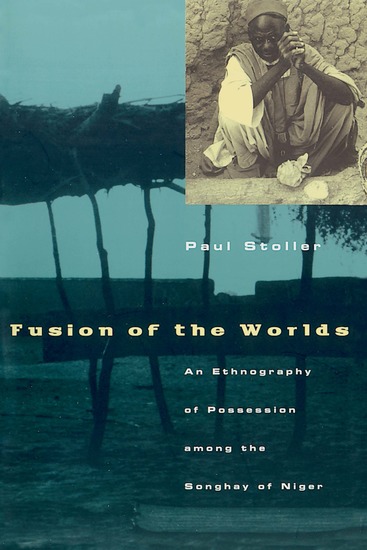
  • Fusion of the Worlds - An Ethnography of Possession among the Songhay of Niger - cover

    Fusion of the Worlds - An...

    Paul Stoller

    • 0
    • 0
    • 0
    "This ethnography is more like a film than a book, so well does Stoller evoke the color, sight, sounds, and movements of Songhay possession ceremonies."—Choice "Stoller brilliantly recreates the reality of spirit presence; hosts are what they mediate, and spirits become flesh and blood in the 'fusion' with human existence. . . . An excellent demonstration of the benefits of a new genre of ethnographic writing. It expands our understanding of the harsh world of Songhay mediums and sorcerers."—Bruce Kapferer, American Ethnologist "A vivid story that will appeal to a wide audience. . . . The voices of individual Songhay are evident and forceful throughout the story. . . . Like a painter, [Stoller] is concerned with the rich surface of things, with depicting images, evoking sensations, and enriching perceptions. . . . He has succeeded admirably." —Michael Lambek, American Anthropologist "Events (ceremonies and life histories) are evoked in cinematic style. . . . [This book is] approachable and absorbing—it is well written, uncluttered by jargon and elegantly structured."—Richard Fardon, Times Higher Education Supplement "Compelling, insightful, rich in ethnographic detail, and worthy of becoming a classic in the scholarship on Africa."—Aidan Southall, African Studies Review
    Ver livro