Join us on a literary world trip!
Add this book to bookshelf
Grey
Write a new comment Default profile 50px
Grey
Subscribe to read the full book or read the first pages for free!
All characters reduced
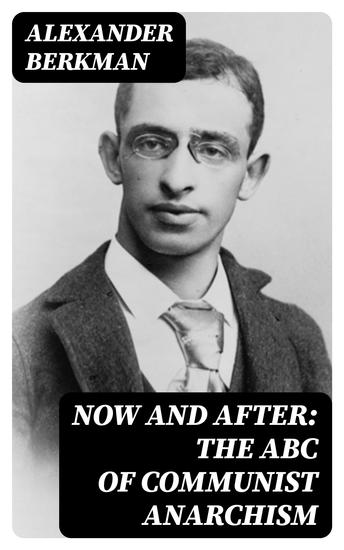
Now and After: The ABC of Communist Anarchism - cover

Now and After: The ABC of Communist Anarchism

Alexander Berkman

Publisher: DigiCat

  • 0
  • 0
  • 0

Summary

In 'Now and After: The ABC of Communist Anarchism,' Alexander Berkman presents a profound exploration of anarchist philosophy, particularly its intersection with communist ideology. Through a direct and accessible prose style, Berkman elucidates complex political concepts, making the text both intellectually engaging and practically relevant. He critiques state power and capitalism, advocating for a societal transformation rooted in mutual aid and voluntary cooperation. Drawing from historical movements and his own experiences, Berkman situates his arguments within the broader context of early 20th-century radical thought, making this work a crucial reference for understanding the evolution of anarchist theory. Alexander Berkman (1870-1936), a prominent anarchist thinker and activist, was deeply influenced by the socio-political landscape of his time, including the Russian Revolution and the subsequent rise of totalitarian regimes. Berkman's own experiences, including his imprisonment for a failed assassination attempt on an industrialist, shaped his perspectives on individual freedom and collective action. His life's work embodies a commitment to social justice, making 'Now and After' both a personal testament and a scholarly contribution to anarchist literature. This essential work is recommended for anyone seeking insight into anarchist critiques of modern society and the foundational principles of communist anarchism. Readers will find Berkman's ideas strikingly relevant in today's discussions on freedom, social hierarchy, and the quest for equality. Whether one is a seasoned activist or a curious newcomer to political philosophy, Berkman's work provides a compelling and thought-provoking exploration of the possibilities for social change.
Available since: 05/29/2022.
Print length: 238 pages.


Other books that might interest you

  • The Neoliberal Revolution - How Neoliberalism Transformed Global Economies - cover

    The Neoliberal Revolution - How...

    Arlo Holders

    • 0
    • 0
    • 0
    Neoliberalism is a term widely used to describe a set of economic policies and ideas that emphasize the importance of free markets, deregulation, privatization, and limited government intervention. Emerging in the mid-20th century, neoliberalism represented a distinct shift away from the welfare state and Keynesian economics, which had dominated Western economies in the post-World War II era. At its core, neoliberalism advocates for the belief that markets, if left to operate freely, will create wealth, drive economic growth, and improve human well-being. This chapter introduces the key tenets of neoliberal thought and traces its rise to prominence. 
    The intellectual origins of neoliberalism can be traced back to economists and thinkers such as Friedrich Hayek, Milton Friedman, and Ludwig von Mises, who were critical of state intervention in the economy. They argued that government efforts to regulate markets, redistribute wealth, and promote social welfare were inefficient and counterproductive. Instead, they believed that economic freedom, unencumbered by regulation or state control, would lead to more prosperous societies. These ideas gained traction in the 1970s when the world was facing economic stagnation, inflation, and high unemployment, a period often referred to as the “stagflation” crisis. 
    As a response to these challenges, neoliberalism became the intellectual and policy framework that justified sweeping changes in global economic practices. It was championed by leaders such as British Prime Minister Margaret Thatcher and U.S. President Ronald Reagan, who implemented reforms based on neoliberal principles. These included reducing taxes, privatizing state-owned industries, cutting social welfare programs, and embracing global free trade. The goal was to increase individual freedom and market efficiency by minimizing the role of the state in economic affairs.
    Show book
  • Calculus of Consent The: Book Summary & Analysis - cover

    Calculus of Consent The: Book...

    Briefly Summaries

    • 0
    • 0
    • 0
    This is a concise summary and analysis of The Calculus of Consent, by James M. Buchanan and Gordon Tullock.
     
    It is not the original book and is not affiliated with or endorsed by 
    James M. Buchanan and Gordon Tullock.
    Ideal those seeking a quick and insightful overview.
     
    The Calculus of Consent is a groundbreaking exploration of decision-making processes within democratic systems. This classic work combines political science and economic theory to analyze how collective decisions are made, emphasizing the balance between individual preferences and group consensus. It introduces the framework of public choice theory, examining the trade-offs and costs involved in collective governance, and provides insights into the challenges of achieving fairness and efficiency in democratic institutions. A foundational text, this book remains a vital resource for understanding the dynamics of political cooperation and the limitations of collective action.
    Show book
  • The Conquest of Bread - cover

    The Conquest of Bread

    Peter Kropotkin

    • 0
    • 0
    • 0
    The Conquest of Bread  is an 1892 book by the Russian anarcho-communist Peter Kropotkin.
    Peter Kropotkin was born a Russian prince whose father owned 1,200 serfs. But he became  a Russian activist, writer, revolutionary, scientist, economist, sociologist, historian, essayist, researcher, political scientist, biologist, geographer  and philosopher.
    The Conquest of Bread has become a classic of political anarchist literature. It was heavily influential on both the Spanish Civil War and the Occupy movement.
    In the work, Kropotkin goes on to propose a more decentralized economic system based on mutual aid and voluntary cooperation, asserting that the tendencies for this kind of organization already exist, both in evolution and in human society.
    Show book
  • Policy Making - A Comprehensive Guide to Finding the Right Policies - cover

    Policy Making - A Comprehensive...

    Kevin Thorley

    • 0
    • 0
    • 0
    Policy making is a crucial aspect of governance that directly influences the well-being of citizens and the development of a nation. It is designed to promote the general welfare of the population, addressing issues such as health, education, and public safety to ensure that the needs of citizens are met. Economic policies play a significant role in managing the economy by promoting growth, reducing unemployment, and controlling inflation, which leads to a more stable and prosperous society. 
      
    Moreover, policy making is essential for reducing social inequalities by providing support to disadvantaged groups through measures related to housing, social security, and anti-discrimination. Environmental policies are also vital for the sustainable management of natural resources and the protection of ecosystems, addressing issues such as climate change, pollution, and conservation. In terms of national security, policies related to defense, immigration, and foreign relations are critical for maintaining security and protecting the country from external threats. 
      
    Policy making also encourages innovation and progress by funding research and development, supporting new technologies, and creating a favorable environment for entrepreneurship. It provides a framework for regulation and oversight, ensuring that industries operate fairly and safely, covering areas such as financial regulations, consumer protection laws, and labor standards. Additionally, the policy-making process allows for public participation and democratic governance, giving citizens a voice in how they are governed and ensuring their interests are represented.
    Show book
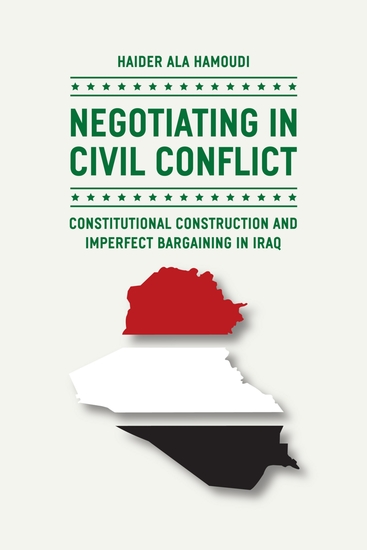
  • Negotiating in Civil Conflict - Constitutional Construction and Imperfect Bargaining in Iraq - cover

    Negotiating in Civil Conflict -...

    Haider Ala Hamoudi

    • 0
    • 0
    • 0
    In 2005, Iraq drafted its first constitution and held the country’s first democratic election in more than fifty years. Even under ideal conditions, drafting a constitution can be a prolonged process marked by contentious debate, and conditions in Iraq are far from ideal: Iraq has long been racked by ethnic and sectarian conflict, which intensified following the American invasion and continues today. This severe division, which often erupted into violence, would not seem to bode well for the fate of democracy. So how is it that Iraq was able to surmount its sectarianism to draft a constitution that speaks to the conflicting and largely incompatible ideological view of the Sunnis, Shi’ah, and Kurds? Haider Ala Hamoudi served in 2009 as an adviser to Iraq’s Constitutional Review Committee, and he argues here that the terms of the Iraqi Constitution are sufficiently capacious to be interpreted in a variety of ways, allowing it to appeal to the country’s three main sects despite their deep disagreements. While some say that this ambiguity avoids the challenging compromises that ultimately must be made if the state is to survive, Hamoudi maintains that to force these compromises on issues of central importance to ethnic and sectarian identity would almost certainly result in the imposition of one group’s views on the others. Drawing on the original negotiating documents, he shows that this feature of the Constitution was not an act of evasion, as is sometimes thought, but a mark of its drafters’ awareness in recognizing the need to permit the groups the time necessary to develop their own methods of working with one another over time.
    Show book
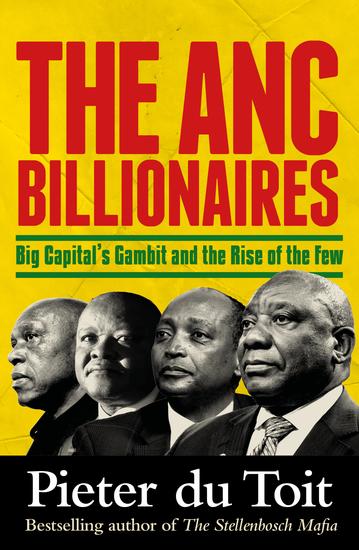
  • The ANC Billionaires - Big Capital's Gambit and the Rise of the Few - cover

    The ANC Billionaires - Big...

    Pieter Du Toit

    • 0
    • 0
    • 0
    'We were talking about the rise of Japan, about Ronald Reagan's Star Wars … globalisation, technology. And they were still banging on about the Freedom Charter.' – Anglo American's Michael Spicer on the ANC in the mid-1980s.
    In 1985, a group of white South African business leaders, led by Gavin Relly, the executive chairperson of Anglo American, travelled to a game lodge in Zambia to meet with the exiled ANC leadership under Oliver Tambo and Thabo Mbeki. This visit set in motion a coordinated and well-resourced plan by big business to influence and direct political change in South Africa.
    In The ANC Billionaires, top-selling author Pieter du Toit draws on first-hand accounts by major roleplayers about the contentious relationship between capital and the ANC before, during and after the country's transition to democracy, and shows how the liberation organisation was completely unprepared to navigate the intersection between business and politics.
    He also ties the rise of the new elite – including Cyril Ramaphosa, Patrice Motsepe and Saki Macozoma – to the ANC, a party of government and patronage.
    Show book